ANDREW J. GRAHAM
ANDREW
J. GRAHAM, deceased. Few men in Leonidas Township were more widely or favorably
known than the subject of this record. Liberal and public spirited, he not alone
labored for his own advancement, but since the time of his coming here maintained
a lively interest in the progress and welfare of the community about him. He
was undeniably one of those men who leave their mark where they have lived,
and whose names are remembered long after they have departed hence.
The fifth child of ORSON and PHEBE (BARTLETT) GRAHAM,
our subject was born in Italy, Yates Co., N.Y., Feb. 10, 1828. He continued
a resident of his native county until reaching his majority, then learned the
carpenter's trade, which he followed in the Empire State afterward for a period
of eleven years. He continued this employed for two years after coming to Michigan.
After that time his attention was mostly given to agricultural pursuits. As
a farmer he was thorough and skillful, and as a business man prudent and fortunate
in his investments.
ORSON GRAHAM was born in Chester, Windham Co., Vt., and
his wife, PHEBE, in the town of Marcellus, Mass. After marriage the parents
of our subject settled in Italy, N.Y., whence in 1884 they changed their residence
to Lima, in Livingston County, where the mother died a few years later. The
father passed away in Honeoye, Monroe Co., N.Y. The parental household included
seven sons and three daughters. Our subject left Livingston County, N.Y., in
1852, and coming to Michigan settled in the unimportant village of Colon, where
he prosecuted his trade of carpenter until 1854, then settled upon a tract of
land embracing a portion of section 29, in Leonidas Township. His first purchase
embraced 120 acres, to which he added as time passed on, and erected the necessary
farm buildings for the convenience of himself and family, the storing of grain
and the shelter of stock. In the year 1880, during a violent storm the barn
and other building were struck by lighting and entirely destroyed. The house
also caught fire, but was fortunately saved; he also lost five horses by the
fire.
Notwithstanding these losses he was what may be termed
prosperous, and was generously rewarded for his labors. A new set of buildings
soon replaced the old ones which had been destroyed, and the farm with its appurtenances
bears fair comparison with anything of the kind in St. Joseph County.
For thirty-one years walked by the side of our subject
as his faithful companion and helpmate a lady who in her girlhood was MISS HELEN
WILCOX, and to whom he was married Sept. 19, 1857. MRS. GRAHAM is the daughter
of NEWCOMB and MIRANDA (STEARNS) WILCOX, who were natives of Naples, Ontario
Co., N.Y. There also they were reared and married, and lived for a time afterward,
and then, in 1837, came to the new State of Michigan, locating in Sherwood Township,
Branch County. There the mother died in March, 1884. MR. WILCOX is still living.
Their family included two sons and five daughters, six of whom are living.
MRS. GRAHAM was born in Naples, N.Y., May 21, 1833, and
was the fourth child of her parents. She was but four years old when they came
to Michigan, and was reared at the homestead in Branch County. She was educated
at Albion, Mich., and taught school eight years, receiving $16 per month, the
highest wages she ever received; she had taught as low as $6 per month. Of her
brothers and sisters, seven in number, all were teachers. One of her sisters
is at present a preceptor at Ludington, Mich. MRS. GRAHAM taught six days a
week, and boarded around among the neighbors. Of her marriage there were four
children, of whom the record is as follows: ORSON B. married MISS LONISA BEARD,
and is farming in Leonidas Township; NANNIE is the wife of CLARENCE KENT, of
Union City, this State; LEWIS B. married MISS SADIE LONGNECKER, and is living
on a farm in Leonidas Township; HARRY died when a babe of seven months.
MRS. GRAHAM has been a member of the Baptist Church since
eighteen years of age, and still preserves her interest in its advancement and
prosperity. MR. GRAHAM, politically, was an old-styly Jacksonian Democrat, and
defended his principles with all the natural strength of his character. Considering
the fact that he came to Colon Township with the modest capital of $300, it
is to be acknowledged that he did well.
The following extract relating to the death of MR. GRAHAM,
a highly respected citizen of Leonidas Township, departed this life Nov. 22,
1888. He was one of a family of ten children, five of whom survive him. He was
born in Italy, Yates Co., N.Y., Feb. 10, 1828. He came to the State of Michigan
in 1855, and worked at his trade, that of a carpenter and joiner. In 1856 he
was married to HELEN N. WILCOX, a daughter of NEWCOMB WILCOX, of Sherwood, after
which he located at Colon and engaged in manufacturing. In 1858 he moved into
the township of Leonidas and settled upon the farm where he died, which was
then almost a wilderness. He had been in poor health for nearly twenty years,
but bore his troubles uncomplainingly. He was an upright citizen, and lived
so that he enjoyed the esteem and confidence of his neighbors, and departed
this life with the assurance of rest in heaven. He leaves a wife and three children
to mourn the loss of a kind husband and father. In his last sickness he was
conscious to the last, commended his family to the care of God, and spoke with
rapture of the beautiful things he saw.
'We shall meet, but we shall miss him,
There will be one vacant chair.'
but, 'Blessed are the dead who die in the Lord.'
GEORGE D. CLARK
GEORGE D. CLARK. The pleasant
country home of this gentleman, which forms on of the attractive features of
Nottawa Township, and which embraces a portion of section 12, is one within
which intelligence, culture and education are at once apparent as the leading
attributes. The dwellers there, while giving due attention to labor and its
attendant comfortable results, have most wisely kept in view the higher life,
and never permitted the acquisition of gain to infringe upon those duties and
privileges by which the human race is distinguished from the lower animals.
Reading thought and study have made the home of MR. CLARK attractive to the
cultured classes, both among friends and strangers.
The subject of this sketch is a son of one of the honored
pioneers of St. Joseph County, and first opened his eyes to the light near the
homestead which he now occupies, May 4, 1840. His father JASON CLARK, was a
native of Onondaga County, N.Y., and married MISS LUCY A. DUNHAM, one of the
associates of his childhood. They emigrated to the Territory of Michigan in
the summer of 1834, settling in the month of June on a tract of land in Nottawa
Township. The father for a period of ten years battled with the elements of
pioneer life, and was then called hence, his decease taking place in 1844, when
his son, our subject, was a little lad four years of age. The mother is still
living, having reached an advanced age, and makes her home in Kalamazoo County.
The parental family included five sons and two daughters,
three of whom are living. Of these GEORGE D. was the third in order of birth.
He was reared upon the farm and conned his first lessons in the district school.
Later he attend Colon Seminary and the Union schools at Mendon and Three Rivers.
He had just attained his majority upon the breaking out of the late Rebellion,
and in September following enlisted in the 11th Michigan Infantry for one year.
Soon after receiving his honorable discharge he again entered the ranks, as
a member of the 1st Brigade, 3d Division, 14th Army Corps, and thereafter continued
in the service of his country until the preservation of the Union was assured.
He endured the usual hardships and privations incident to a soldier's life,
but fortunately escaped wounds and capture, and soon after receiving is honorable
discharge at Springfield, Ill., returned to his native township.
MR. CLARK being desirous of adding to his store of knowledge,
resumed his studies in the Albion College, where he was graduated from the commercial
department, and upon emerging from this institution resumed farming on a tract
of land in Nottawa Township. His first purchase was eighty acres on section
12, upon which he has effected the improvements which we behold to-day. The
residence is neat and substantial, and the barn amply indicative of thrift and
enterprise. MR. CLARK keeps a goodly assortment of livestock in the shape of
cattle, horses and swine, and to these gives the needful care and attention,
which to him is a matter of pride as well as profit. He has now ninety acres,
the greater part of which has been thoroughly cultivated, and yields abundantly
the rich crops of this region. His nearest trading point is the town of Mendon.
On his return from the army MR. CLARK was united in marriage,
in 1869, in the little city of Burr Oak, to MISS IDA PINE. This lady was born
in Hancock, Delaware Co., N.Y., May 15, 1846, and is the daughter of ALFRED
and PHEBE A. (PATRICK) PINE, who were also natives of the Empire State. The
former died in 1864; the latter is still living, and resides with MR. CLARK.
To MR. and MRS. CLARK there has been born one child only, WARREN P., who is
now attending Albion College.
MR. CLARK, politically, is a Republican with strong Prohibition
tendencies, usually voting the Republican ticket. Both he and his estimable
wife are members in good standing of the Methodist Episcopal Church, in which
Mr. CLARK has held the office of Steward and Superintendent of the Sunday school.
As an ex-soldier he belongs to WILLIAM F. CURTENIUS Post, G.A.R., at Mendon.
Both MR. and MRS. CLARK maintain a lively interest in educational matters, and
in all the enterprises set on foot tending to the moral and religious welfare
of the community, there they found giving of their means and influence. Their
home abounds with books, papers and magazines, which at once indicate the manner
in which they spend their leisure hours.
G.D. CLARK has in his possession an old family Bible
in a good state of preservation, purchased by his grandfather on his father's
side in 1814. It was printed in 1812. JASON CLARK and LUCY CLARK, our subject's
parents, drew up and signed a temperance pledge in 1837, and kept it until the
day of their death; it reads as follows:
Family Temperance- We this day solemnly agree to never
more drink spirituous liquors, except in sickness.
JASON CLARK
LUCY CLARK
MRS. CLARK has the original manuscript in fair state of preservation. (Noted
by transcriber, Carole Carr)
HENRY W. WARREN
HENRY N. WARREN. The most interesting
period in the life of the subject of this biography, and one which he considers
of the most importance, was that spent as a Union soldier in the service of
his country. To that he looks back upon with satisfaction as to a time in which
he, with thousands of others, was tried and not fund wanting. He laid down the
musket for the plowshare over twenty years ago, but recalls those years even
with their difficulties and hardships as among the most satisfactory of his
life, in that he did not give his efforts to his country in vain. He has since
followed the peaceful pursuits of agriculture, and for a period of over thirty-five
years has been a resident of this county. He has now a good farm lying on section
24, in Leonidas Township, where he has built up one of the most creditable homesteads
within its limits. He is a thorough and skillful agriculturist, a genial, hospitable
and companionable man to meet, and one with whom may be passed many a pleasurable
and profitable hour.
EPHRAIM WARREN, the father of our subject, and his wife,
MARGARET (HOLDERIDGE) WARREN, removed from Ontario County, N.Y., in 1853 to
Michigan, and settled upon a tract of land in Leonidas Township, this county.
The father only lived five years thereafter, his death taking place in 1858.
The mother survived her husband a period of twenty-one years, remaining a widow,
and departed this life at the old homestead, in February, 1879. The household
circle included eight children, five sons and three daughters, five of whom
are living.
The subject of this sketch, the third child of his parents,
was born in Naples, Ontario Co., N.Y., Sept. 22, 1840. He became familiar with
farm pursuits at an early period in his life, and with the exception of the
three years spent in the service of his country has bent his energies in this
direction. He first trod the soil of Michigan in 1853, when a lad of thirteen
years, and has since been a resident of Leonidas Township.
A few months after the outbreak of the Rebellion and
a little before reaching his majority, young WARREN enlisted, Aug. 24, 1861,
in Company G, 11th Michigan Infantry, and much of the time thereafter did Corporal
duty. He participated in many of the important battles of the Army of the Cumberland,
and in the fight at Mission Ridge was slightly wounded in the right foot. He
was in the engagement at Stone River, Chickamauga, Missionary Ridge, at Atlanta
during the latter part of the siege, and met the rebels in various other engagements
and skirmishes. Otherwise than the natural results of hardship and privation
he came out comparatively unharmed, and received his honorable discharge in
1864, being mustered out at Sturgis, this State.
Upon returning to civil life MR. WARREN resumed his residence
in Leonidas Township, and in 1872 was united in marriage with MISS LYDIA, daughter
of WILLIAM and ANN (STIMERS) BILLINGS. The parents of MRS. WARREN were both
natives of New York, and the mother spent her last years in Michigan, dying
in March; 1887. The father is still living. The family consisted of five children,
and MRS. WARREN was the second child of the family. She was born Feb. 8, 1849,
in Genesee County, N.Y.
It is hardly necessary to say that MR. WARREN, politically,
is an earnest Republican, and supports the principles of his party in the conscientious
manner which has marked all his sentiments in life. The WARREN homestead is
one of the pleasantest in this part of the county, and under its hospitable
roof gather from time to time the warm friends whom the proprietor and his excellent
wife have gathered around them by a straightforward career which has been unmarked
by a dishonest deed.
JOHN SCHERMERHORN
JOHN SCHERMERHORN. There are a
few men in every community distinguished for their intelligence, their liberality
and their progressive ideas. Among this class may be mentioned the subject of
this sketch, who has improved the years of a long and pleasant life in the acquirement
of useful knowledge, and in disseminating those principles which have influenced
his own career. The friend of temperance and good order, he is a pronounced
Prohibitionist, and in religious matters a member in good standing of the Dutch
Reformed Church, with which he identified himself many years ago. He is residing
quietly on his pleasant farm in Nottawa Township, and which embraces about 190
acres of good land on section 21. He has comfortable and substantial farm buildings,
and by a life of industry has secured a competence for his declining years.
Our subject was born in Schenectady County, N. Y., at
the modest home of his parents, five miles from the town of Schenectady, Jan.
25, 1810. His father, JOHN SCHERMERHORN, Sr., and his mother, who in her girlhood
was MISS MARIA SLATER, were also natives of the Empire State. JOHN, Jr., was
the second born in a family of five children, all of whom lived to mature years,
but of whom four are now living. Our subject spent the early years of his life
at the old homestead in his native county, engaged, until a youth of sixteen,
in the various employments connected therewith. He now commenced learning the
cooper's trade, which he followed until setting out in life on his own account,
when he concluded to turn his attention again to agricultural pursuits.
The first property of young SCHERMERHORN was a farm in
Rotterdam Township, in his native county, upon which he operated until 1866.
He then determined on a change of location, and selling out, removed with his
family westward to this county, settling in Nottawa Township, of which he has
since been a resident.
Our subject was married, in Schenectady County, N.Y.,
to MISS REBECCA VEDDER, who was also born there, June 21, 1814. This union resulted
in the birth of eight children, and the mother departed this life at her home
in Nottawa Township, this county, Sept. 4, 1887, when a little over seventy-three
years old. Their eldest son, JOHN, died in childhood; MARIA is the wife of CORNELIUS
VIELE, and they are now living in Hillsdale County; EDITH married WARREN
WEST, who is occupied in farming in Nottawa; ROBERT is carrying on farming
in Nottawa Township; Francis was a carpenter by trade, and died in Nottawa Township,
at the age of thirty-six years, in 1883; OMIE died at the age of thirty years;
JOHN is farming in Nottawa Township, and SARAH remains at home with her father.
IRA F. PACKARD
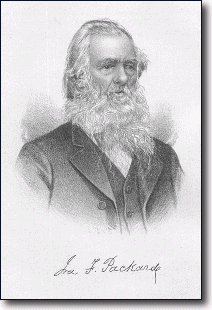
Dr. Ira F. Packard, a retired
physician and surgeon of Sturgis, and a man who is well known throughout Southern
Michigan, both as a practitioner and a citizen, is the subject of a most interest
history, which is substantially as follows: Born on the 7th of June, 1808, our
subject is a native of Royalton, Windsor Co., Vt., and the youngest son of Benjamin
Packard, who was the youngest son of Elijah Packard, the latter of whom
settled at an early day in the town of Bridgewater, Mass.
Benjamin Packard, the father of Ira, moved to
the town of Royalton, in the State of Vermont, soon after the close of the Revolutionary
War. Nothing of especial note occurred during the boyhood of our subject, his
time being spent mostly in obtaining such education as the schools of that day
afforded, while he employed his time during vacation working on the farm. When
he was fifteen years old he was deprived of a father's care by death, and was
thrown upon his own resources in completing his education and obtaining a living.
In the spring of 1824 young Packard repaired to Boston, Mass., and took
a position in the wholesale and retail store of Kittridge & Wyman,
dealers in groceries and West India goods. He continued through the summer and
fall with this firm, then returned home to attend the winter term of school
in his native town.
 In the spring of the year 1825, our
subject entered the service of the whale ship "Alexander,"
and upon the long voyage which followed gathered much information in regard
to a seafaring life and the world in general. The ship returned to New
Bedford in the month of July following, with a cargo of oil and bone,
and Mr. Packard subsequently made upon her several other short
voyages. The fall of 1828 found him in Philadelphia, Pa., where he was
engaged for a brief time in the Pottsville mines as the employee of Aaron
Burr, and which were in charge of his nephew George. In February,
1829, he migrated to Allegany Co., N.Y., settling in the town of Pike,
which was the home of a brother, and where he sojourned a brief time;
then going to Yorkshire in Cattaraugus County, he established himself
in the mercantile business. On the 27th of April, 1829, he was married
to Miss Emily M., daughter of Col. Araunah Hibbard.
In the spring of the year 1825, our
subject entered the service of the whale ship "Alexander,"
and upon the long voyage which followed gathered much information in regard
to a seafaring life and the world in general. The ship returned to New
Bedford in the month of July following, with a cargo of oil and bone,
and Mr. Packard subsequently made upon her several other short
voyages. The fall of 1828 found him in Philadelphia, Pa., where he was
engaged for a brief time in the Pottsville mines as the employee of Aaron
Burr, and which were in charge of his nephew George. In February,
1829, he migrated to Allegany Co., N.Y., settling in the town of Pike,
which was the home of a brother, and where he sojourned a brief time;
then going to Yorkshire in Cattaraugus County, he established himself
in the mercantile business. On the 27th of April, 1829, he was married
to Miss Emily M., daughter of Col. Araunah Hibbard.
This business
venture of Mr. Packard not proving a bonanza, he closed out, and going
into Erie County, Pa., engaged in the grocery and provision trade upon the present
site of the custom house there. Here he was again doomed to disappointment,
the cholera breaking out and all business being suspended for the time. Not
being possessed of capital by which he could lay idle, he was compelled to close
out his business. He then returned to Yorkshire, and engaged as clerk with Messrs.
A. & W. Hibbard.
In the spring
of 1836 our subject commenced the study of medicine and surgery under the
instruction of
Dr. Bela H. Colegrove, of Sardinia, Erie Co., N.Y., with whom he continued
a period of three years. In the meantime he attended medical lectures in the
Western college of Physicians and Surgeon at Fairfield. Upon completing his
studies he removed with his family to the town of Sherman, now Sturgis, this
county, of which he has since been a resident.
Having secured a lucrative practice, Dr. Packard
followed his profession continuously until the spring of 1850, when his close
application to his duties began to have a perceptible effect upon his health.
He now decided upon a trip to California, and accordingly spent the summer following
in the gold fields of the New Eldorado. He was successful in the mines, obtaining
a reasonable recompense for his time and trouble. He returned to Sturgis in
the spring of 1851, and practically retired from practice, although occasionally
treating the old friends who were unwilling to give their cases into new and
strange hands.
Since withdrawing from his profession Dr. Packard
has been identified with various business enterprises in the city, serving as
a Director of the National Bank. He has distinguished himself as a public-spirited
citizen, one having a warm interest in the growth and progress of his adopted
State. In religious sentiment he possesses a broad, liberal and Catholic spirit,
and while being a man of decided views, with his own peculiar beliefs and convictions,
he willingly accords that same privilege to others without comment or reflection.
He was originally a Whig in politics, and upon the organization of the Republican
party cordially embraced its principles, and has been a supporter of its general
policy up to the present time.
Dr. Packard and his wife became the parents of
a family of five children, three sons and two daughters, the record of whom
is as follows: Nelson I. was born April 8, 1830, and married Miss Lizzie A.
Toby, Oct. 15, 1856; they have no children. This son is President of
the National Bank of Sturgis, a man of fine talents, and a highly respected
citizen. Homer H. Packard was born Aug. 10, 1832, and married Miss Sarah
C. Stillman, Dec. 9, 1959; he is a druggist by profession, and a resident
of Cheboygan, this State; he has no children. Emily M. was born Nov. 6, 1834,
and was married to Henry S. Church, Oct. 25, 1860; Mr. C. is a grocer
in good circumstances, and a resident of Sturgis; they have no children. Frank
S. was born Feb. 10, 1838, and was married, Sept. 25, 1860, to Miss Jane E.
Clark; they have three children, Frank I., Gertrude A. and James J.,
and are residents of Sturgis; his son Frank , Jr., was born Aug. 17, 1861, became
a youth of great promise, choosing the profession of medicine, and was graduated
from Ann Arbor (Mich.) Medical College; he died at Cheboygan, Feb. 8, 1888.
Gertrude A. married Nelson Upham, and lives in Cheboygan, being the mother
of one son, Frank Sherman; James J. was born Oct. 8, 1868, married Miss Bertha
Miner, and is the father of two children, a son Frank and a daughter.
Lucina M. Packard was born Jan. 26, 1843, and married Thomas J. Acheson,
Oct. 1, 1863. They have three sons; Frederick I., born April 29, 1866; Nelson
H., May 17, 1874; and Thomas J., Aug. 7, 1885. All live in Emporia, Lyons Co.,
Kan.
The ancestral history of this branch of the Packard
family is as follows: Probably the first representative in this country was
one Samuel Packard, who, with his wife and eight children, came from
Windham, near Hingham, in England, in the ship "Diligence," of Ipswich,
with 133 passengers, John Martin, Master, and settled in Hingham, in
the year 1638. Thence he went to Bridgewater, Mass., where he died in 1684.
He was the father of twelve children, namely: Elizabeth, Samuel, Zaccheus, Thomas,
John, Nathaniel (our subject), Mary, Hannah, Israel, Joel, Deborah and Deliverance.
Nathaniel, one of the sons of Samuel Packard,
and the great-great-grandfather of our subject, married, a daughter of John
Kingman, and became the father of thirteen children, namely: Samuel;
Zachariah, the great-grandfather of our subject; George, Fearnot, Margaret,
Sarah, Lydia, Faithful, Hannah, Deliverance, Elizabeth, Mary and Deborah. Zachariah
married Abigail, the daughter of Richard Davenport, in 1724, and became
the father of four children-Elijah, Abigail, Nathaniel and Nathan. Rev. Elijah,
the son of Zachariah, was graduated from Howard University in 1750, and settled
in the ministry at Plymouth, in 1764. He afterward went to Marlboro, and was
married to Mary Rider; they became the parents of four children-Abigail,
Benjamin, Elijah and Mary. Benjamin married Mehitable Fobes, daughter
of Eliab Fobes, in 1782, and moved to Vermont in 1784, their son Lyman
was born in January of that year, and died in December, 1819; Benjamin, who
was born July 15, 1787, died April 13, 1869; Charles was born June 28, 1790,
and died Nov. 13, 1808; Luch was born May 21, 1800, and died March 17, 1803;
Silas was born in 1795, and died Sept. 8, 1830; Lucinda was born May 8, 1805,
and died Oct. 27, 1831. Their youngest son was Ira, the subject of this sketch.
Benjamin Packard, the father of our subject, who
was born in Bridgewater, June 7, 1760, served as a Lieutenant in the Revolutionary
War, and was on duty at the battles of Lexington and Bunker Hill, and witnessed
the surrender of Geo. Burgoyne. He was wounded by a ball across the breast,
and by buckshot in the arm. He saw the smoke rise from behind a bush, and shot
through the bush, and said there was no more smoke came up from behind the bush.
Elijah Packard, the paternal grandfather of our subject, was murdered
by a robber and highwayman, one Bolton, who was afterward hung for robbery
in Canada, confessing his guilt on the scaffold. Dr. Ira S., our subject, has
a deed done in the handwriting of his grandfather, Aug. 29, 1765. He also has
the old family Bible in two large volumes, which was printed in London, England,
in 1683, and was bought by Grandfather Elijah Packard. It has written
on the fly-leaf-"Elijah Packard, his book, price f21. Bought of
William Joseph Snell, of Bridgewater, in the years 1752." that sum
in American money would be $101.64.
Mrs. Emily M. (Hibbard) Packard, the wife
of our subject, was born in Clarence, Niagara Co., N.Y., April 23, 1811, and
was the first female white child a native of that county. Her father was Col.
Araunab Hibbard, a soldier of the War of 1812, who was severely wounded
at Queenstown Heights. He was one of two brothers who came from England at an
early day.
SOLOMON L. DENTLER
Solomon L. Dentler is classed
among the most practical, wide-awake and successful farmers of St. Joseph County.
His farm on section 26, Constantine Township, is amply provided with substantial
buildings for every necessary purpose. Its carefully tilled acres yield abundant
harvests, and it is altogether considered one of the most desirable farms in
this section of the county.
Our subject was born July 2, 1824, in Turbotville, Northumberland
Co., Pa., and is a son of Solomon L. and Esther (King) Dentler,
both of whom were natives of that county, where also both died. They had a family
of twelve children, seven of whom lived to maturity. The children were named:
John, now a resident of White Rock, Ogle Co., Ill.; Barbara, wife of Phineas
Hangenbuch, of Alexandria County, Va.; Jacob, living in Northumberland
County, Pa.,; then came Solomon L.; Samuel, a resident of Union County, Iowa;
Eliza died at the age of ten years; George, Esther and Lucy died in childhood,
and two infants died unnamed. Peter, who was a resident of Lycoming County,
Pa., died in July, 1888.
Our subject was reared on his father's farm until he
was eighteen years old, and he was then apprenticed to learn the miller's trade.
He followed that occupation many years in Pennsylvania, and until he came to
St. Joseph county in the spring of 1865. He then turned his attention to farming,
the pursuit to which he had been reared. He purchased 120 acres of good land
in Constantine Township, and has ever since been a resident of this place. His
arduous labors in improving his land have been amply rewarded in the good income
that he derives from its cultivation. He has erected a good set of farm building,
complete in all their appointments, and has been so fortunate in his ventures
that he has purchased more land, and his farm now comprises 175 acres of land,
as well tilled and fertile as any in the neighborhood.
November 16, 1852, the marriage of our subject to Miss
Elizabeth A. Narber was solemnized in Danville, Montour Co., Pa. Mrs.
Dentler was born Nov. 14, 1834, in Lycoming County, Pa., her parents
having been Jacob and Susanna (Good) Narber, who died in that
county. Mr. And Mrs. Dentler have had five children, namely: Alice B.,
who is the wife of Rev. S. George, of Allen, Branch Co., Mich.; H. H.
Beecher and Colfax B., living at home, and Grant A., a student at Wittenberg
College, Springfield, Ohio. They have lost one child, Narber L., who died when
three years old. When Mr. Dentler made his first purchase, forty of his
120 acres was in timber, and this, with the exception of a few acres, he cleared
himself, not being financially in a condition to employ help. Almost all of
the fifty-five acres subsequently purchased he also cleared, but in this latter
was helped by his sons, then growing up.
Mr. Dentler's success in life is attributable
not only to his capacity for work, to his sturdy enterprise and persistent will
power, but also to the fact that he is conscientious and upright in all his
dealings, and does by others as he would like to be done by, thus securing the
respect and confidence of his fellow-citizens. He has ably filled some of the
local school offices, and in other ways performed the duties of a good citizen.
His political views are substantially those of the Republican party, of which
he is an earnest supporter. He and his wife are members of the Lutheran Church,
and actively assist in its good work, and ever since the organization of the
church in this township he has filled some of its official positions, as Elder,
Trustee, etc.
J.A. MARVIN
The Saturday Mail of Sturgis
occupies a prominent position among the newsy journals of the State, and, as
conducted by its present editor and proprietor, exercises no unimportant influence
upon the various questions under discussion by the people of the county. Mr.
Marvin came to Sturgis in 1881, and has been connected with the Mail
since 1886, having edited the Michigan Democrat for four years. He is
a very popular man, an old soldier, and a citizen who has made his mark in his
community.
Mr. Marvin, a native of Rochester, N.Y., was born
in 1844, where he received as good an education as the public schools of that
city afforded until he reached the age of seventeen years, at which time he
enlisted as a Union soldier in the 105th New York Infantry. He served with his
regiment in the second battle of Bull Run, was at South Mountain, Fredericksburg
and Antietam, and after the 105th was consolidated with the 94th New York he,
as a member thereof, was engaged in the battles of Gettysburg. At the expiration
of his first term he re-enlisted for three years, or during the war, and took
part in a number of prominent battles, including that of Five Forks, in which
he received a wound in the head, which came near causing him to be mustered
out for all time.
The record of Mr. Marvin as a soldier was highly
creditable in all respects, and his record as a citizen has been no less so.
After his return from the army he took up his abode in LeRoy, N.Y. On the 12th
of August, 1872, he was married in the city of Hillsdale, Mich., to Miss Emma
A., daughter of Horace P. Hitchcock, one of the pioneers of Hillsdale
County, and now deceased. Of this union there were born two children who died
in infancy, Estella May, in 1874, and Clifton in 1886. The family residence
is pleasantly located opposite the School Park, and is the resort of many friends.
Genial and hospitable, Mr. Marvin is a universal favorite both in business
and social circles. He learned the printer's trade early in life, and is therefore
well fitted to conduct a newspaper office in all its details. The Mail
was established as a neutral sheet in politics, and in order to fulfill the
promise to its subscribers, still remains so.
In 1888 Mr. Marvin was nominated for Register
of Deeds as the successor of the able and efficient Mr. Hill, and ran
seventy-seven votes ahead of his ticket in Sturgis, lacking only 106 of being
elected.
HENRY SEVISON
Henry Sevison is a fine
representative of the farmers and stock-raisers of St. Joseph County, not only
on account of the wealth he has accumulated in his honorable calling, and that
he owns one of the largest and most valuable farms in Southern Michigan, very
pleasantly located in Florence Township, but that for personal integrity, for
business ability and uprightness of character, he stands pre-eminent among his
fellow-citizens. He is a native of Pennsylvania, born Sept. 21, 1825, in Turbotville,
Northumberland County, to Henry and Elizabeth (Mowerer) Sevison,
natives of Germany, the father born March 14, 1792, and mother in July, 1795.
His parents had seven children, of whom he was the fifth in order of birth,
five sons and two daughters. They died while yet in the prime of life, the father
being drowned in the Susquehanna River, at Muncy dam, Northumberland Co., Pa.,
when our subject was but four years old. At the age of six he went to live with
Mr. William Laird, with whom he lived until he was twenty-four years
old. He came with his kind benefactor to Michigan in 1838, when it had scarcely
begun to merge from its primitive wildness, and ever since that time he has
in one way and another been closely identified with its agricultural and business
interests. He first went to Schoolcraft, St. Joseph County, with Mr. Laird,
but they immediately came to Florence township. Our subject was then a strong
and healthy lad and was of great assistance to his guardian. At the age of fifteen
he took charge of his farm. He had but little time to attend school, but studied
evenings and spare hours through the day. To such men as Mr. Laird, of
whom he took counsel when he was forming his business habits, and Stephen Vickory,
of whom he purchased his farm, he gratefully acknowledges that he owes his success
in life.
Our subject worked for John Talbot, in Centreville,
and while thus engaged enlisted in the war with Mexico, but in a short time
afterward the war closed and his company was disbanded. He first began work
for himself by carrying on a farm on shares in the summer, and in the winter
in making four barrels for the firm of Moore & Protzman, of Three
Rivers. He has always followed farming, though often in connection with other
business, and he bought his first farm of 240 acres when he was twenty-one years
old, having accumulated $300, which he used for his first payment on the land.
He continued for some years to make flour barrels in the winter, still having
his home with Mr. Laird, carrying on his farm for him in addition to
his trade. At one time he engaged for three years in the mercantile business
at White Pigeon, while still managing his agricultural interests. That venture
did not prove the financial success that he had anticipated and he gave it up,
and has since devoted his attention to the management of his large stock interests
and his extensive farm. He became so prosperous in his undertakings that at
one time he owned 1,332 acres of valuable land, but he has given to his children
farms and thus reduced his estate to 1,200 acres of land. For nineteen years
Mr. Sevison has been an agent for the Oliver Plow Company, and has a
large territory that he oversees, having several agents under him whom he keeps
supplied. In all of his dealings he scarcely loses a dollar, and we may mention
here that during his long business career he has never sued but one man, and
then only when every other course for an honorable settlement had failed.
Mr. Sevison has been three times married. His
first marriage took place April 18, 1850, to Anna Burnam, of Florence
Township. She was born in England, June 22, 1831, and came to Michigan with
her parents, likewise natives of England, when she was ten months old. After
a pleasant married life of a few years she passed away Feb, 7, 1857, leaving
three children as follows: Burnam H., George E. and Mary E. Burnam, who lives
in Florence Township, has been twice married, Ella Gentzler, by whom
he had one child, being his first wife, and Elizabeth Greenlee, his second
wife; George E., who lives in Iowa, married Mary E. Briden, and they
have two children; Mary married W. H. Stears, of this township, and they
have one child.
Mr. Sevison's second wife was Rebecca Thompson
before her marriage. She was born May 3, 1835, and died March 25, 1875, having
scarcely reached the meridian of a life which had been a busy and honored one.
She was the first white female child born in St. Joseph County near St. Joseph
River, at a town called Aschol, near Three Rivers; all traces of the town are
now obliterated. Seven children were born of that marriage, namely: Fremont
G., who married Emma Troy, and they have three children; Florence A.,
who married C.H. Lake, of Bancroft, Iowa; Jessie A., wife of John Rheim,
of Logan County, Col.; Grant, born Sept 25, 1863, died March 19, 1866; Luther
J., now engaged with the firm of E.W. Walker, of Goshen, Ind., married Carrie
Dimmick, and they have one child; Martha, born Aug. 21, 1867, died Sept.
4, 1867; Elliot lives at home with his parents. Mr. Sevison has generously
provided for his children; besides giving them land, he has given them several
thousand dollars, and they are well established, in prosperous circumstances,
and are successful in life. Mr. Sevison's third marriage, April 22, 1879,
was to Miss Martha Whited, who was born in Urbana, Ohio, Nov. 8, 1840.
Her parents, natives respectively of New York and Virginia, were married in
Ohio, and had four children, of whom Mrs. Sevison was the eldest.
Mr. Sevison has been very influential in the affairs
of the township, although the pressing claims of his business have not allowed
him to hold office very much. In public as well as in private life he had shown
that keen foresight and discretion that have made him the respected and honored
man that he is today. To his energy and patriotism during the dark days of the
Rebellion is our Government greatly indebted, as he was one of that large class
of citizens who were instrumental in raising the "sinews of war,"
doing as much in their way as the soldiers of the filed, staying at no sacrifice,
and using all the means in their power to furnish men and money for the suppression
of the Rebellion. He was one of the foremost men, at the time when soldiers
were secured by draft, in filling the quota of Florence township, and in aiding
those who were so unfortunate as to be drafted, being called up an any and all
hours of the night to render assistance to his townsmen by taking his team and
driving to Kalamazoo, the Provost Marshal's headquarters, to which office he
was appointed during the war, and helping his neighbors to adjust their difficulties.
Through his individual efforts the township of Florence had the best record
of any township in the county for faithfulness and thoroughness during the ordeal
of filling quotas and raising money. When the legality of a certain draft was
questioned, and an indignation meeting was held at Kalamazoo, Mr. Sevison
was appointed by the board to go to Detroit and confer with Col. Hill,
to procure from him an order to show the illegality of the draft; the board
knowing the energy and indomitable will and influence of our subject, and the
(ordinarily) unapproachable character of the one to be consulted, chose him
as the one best adapted to bring about the desired result. A large assembly
had repaired to the court-house and court-house grounds, anxiously awaiting
the return of Mr. Sevison, to hear the news, in a state of intense excitement,
but on his arrival with his reports the meeting was immediately quieted, and
then our subject, with Hon. Charles Upton, was chosen to Washington,
D.C., where the matter was satisfactorily adjusted and the drafted men were
released. The order was made for three years and these men were called for only
one year, which was the cause of all the trouble. At the close of the war, when
the heavy taxation imposed upon the people was a source of bitterness, again
Mr. Sevison was called upon as arbitrator, when he again succeeded in
adjusting everything satisfactorily and for the bests interests of the people.
Mr. Sevison is an honored member of the Commandery
of K.T., being one of the first members of Sturgis Commandery, and a charter
member of Three Rivers Commandery. He is a strong Republican and a power in
his community. He united with the church at about the age of twenty-one years,
and has been an Elder of the Presbyterian Church for over twenty years, and
he is one of the earnest workers in the building up of the Sabbath-schools,
and taught the first one in Centreville. Our subject's family are all members
of the church and conscientious workers in their respective places.
RICHARD BARNARD
As
a gentleman who, by his enterprise and practical ability has materially advanced
the agricultural interest of St. Joseph County, representing, as he does, two
of its important townships, the subject of this biographical sketch occupies
no unimportant place among its citizens, and should receive due recognition
in this work. He owns two valuable and well-improved farms, one in Florence
Township and one on section 25, Constantine Township. The latter is under his
personal supervision, and there, in the pleasant home that he has built up,
he is passing his declining years.
His parents, William and Eliza W. (Cross) Barnard,
were respected pioneers of St. Joseph County, being among its earliest settlers,
and for many years they were members of its farming community, with patience
and self-sacrifice enduring the hardships of life in the wilderness, that they
might build up a home for themselves and family. They were natives of Yorkshire,
England, and in the year 1833, desiring to better their condition and to give
their children more advantages than they could have in the old country, they
embarked on a sailing-vessel with their family of little children, and bravely
set their faces toward the New World, and after a long and tedious voyage landed
in this country. The same years they made their way to Michigan, and settled
for a short time in this township, near Pigeon River. Later they removed to
another part of the county, and located on the banks of the same river, in what
is now Florence Township. In 1852 Mr. And Mrs. Barnard returned to Constantine
and made their home in the village, and there she died in 1860. One year later
the husband and father, in the fullness of years, after an honorable and useful
life, also passed to his rest from the home of his son, our subject, in Florence
Township.
Richard Barnard, of this sketch, was the fourth
child of the family of six children born to his parents, his birth taking place
in Yorkshire, England, in 1828. He was scarcely five years of age when his parents
abandoned their English home to come to this country, so that most of his life
has been passed here. He was reared on his father's homestead, and doubtless
the pioneer influences that obtained in St. Joseph County at that early date
helped to mold his character, to make him, in short, a strong, self-helpful,
manly man. In 1850, with many other courageous, adventurous spirits, he being
then in the bloom of early manhood, ambitiously sought his fortunes in the mines
of California, proceeding to his destination over the great plains. He remained
a citizen of the Golden State two years, and met with good success in his quest.
But he tired of the rough, hard life of the miner, and at the expiration of
that time returned to his home in this State. He established himself in the
livery business in Constantine, and was thus engaged for a years, and then sold
out to his brother John, who continued the business in Constantine for twenty-five
years, our subject retiring to his farm in Florence. This is still in his possession,
and contains 120 acres of arable land under admirable tillage, and well supplied
with comfortable buildings. In 1872 he took up his abode on his Constantine
farm, which comprises eighty acres of as fine farming land as to be found in
all Southern Michigan. It is carefully cultivated after the most approved methods,
has a neat and handsome set of farm buildings, and everything about the place
denotes the presence of a skilled hand, directed by a clear, well-balanced mind.
Besides giving much attention to tilling the soil, Mr. Barnard is actively
and profitable engaged in buying and shipping stock. July 4, 1885, he met with
a serious financial loss, his dwelling being destroyed by fire, with nearly
all of its contents, entailing a loss of about $3,000. He has since replaced
it by a commodious and conveniently arranged residence.
December 31, 1854, Mr. Barnard was married to
Betsey Hotchin, who was a native of England. When she was eight years
old she came to America with her parents, Samuel E. and Martha Hotchin,
in 1844. They came to St. Joseph County and settled in Constantine Village,
whence they subsequently removed to Florence Township, where her father engaged
in farming, and there died. After a happy wedded life of nearly thirty-two years,
Mrs. Barnard died, March 22, 1886. She was widely respected and beloved
for her many amiable qualities, and as far as in her lay she left no duty undone,
but was ever true in all the relations of life. She was a consistent and valued
member of the Reformed Church. The following is the record of the children born
of that marriage: Mary E. if the wife of E. A. Hamilton, of White Pigeon;
Hattie E. is the wife of Oldos Barry; William is a farmer in Florence
Township, as is also Charles L; and Hannah lives at home.
Mr. Barnard was married to his present estimable
wife, a woman of genuine worth, July 18, 1888, the ceremony taking place in
Plainwell, Allegan Co., Mich. Mrs. Barnard was formerly Mrs. Alvira Bigelow,
widow of Riley Bigelow, and New York was her birthplace, her parents
being Mr. And Mrs. Andrew Hicks.
From the perusal of this sketch it will be seen that
our subject, the son of St. Joseph County's pioneers, has energetically carried
on the work in which his father was engaged, and has been of much assistance
in developing and sustaining the interests of the county. He is a man of varied
experience, of good understanding, keen, prompt, and withal, honorable in his
dealings, and may well be classed among the most trustworthy and esteemed citizens
of St. Joseph County. He was formerly identified with the Reformed church, but
is now a prominent member of the Congregational Church.
JOHN LOHOFF
John Lohoff is numbered
among the most able, enterprising and wide-awake farmers of St. Joseph county,
and in him Constantine Township has one of her most valuable citizens. He there
owns a farm which for fertility, productiveness, neat, tasty and commodious
buildings, is not surpassed by any in the neighborhood, and the dwelling erected
thereon is considered one of the finest in this part of St. Joseph County, and
is an ornament to the locality.
Our subject is a native of Prussia, and his birth occurred
in that distant country April 17, 1832. His parents, John and Anna M. (Lamy)
Lohoff, were likewise natives of that Empire, and there spent their entire
lives. Our subject was reared in his native land, and inherited from virtuous
and industrious parents those traits of character which form the best legacy
that children can inherit to make life a success-an independent, self-reliant
spirit, strong muscles and ability to use them. At the age of twenty years he
decided to try his fortune in America, having been previously engaged in agricultural
pursuits in his native country. After a voyage of some weeks he landed in New
York, and went directly to Canada. He there found employment on the Great Western
Railway, and in a short time he came to Detroit. He worked there six months
in a brickyard, and in the fall of 1852 made his way to St. Joseph County. He
found employment on a farm in Constantine, north of the village, and continued
there until 1862, when he bought a farm in the township, comprising fifty-three
acres. By persistent and untiring labor he has not only brought this land to
an admirable state of cultivation, but has been so successful and has cultivated
it to so much profit that he has been enabled to increase the acreage of his
land by further purchase, so that his farm now comprises 120 acres of well-improved
land, and with its neat and tasty buildings is considered one of the most desirable
estates in St. Joseph County. He has erected one of the finest residences in
this part of the county.
In 1859 Mr. Lohoff made a trip to Pike's Peak
in search of gold. He was away from St. Joseph County in all thirteen months,
six of which were spent in the diggings; not being very successful in the search
for the precious metals he went to Missouri, and from there back to his Michigan
home, arriving in Constantine in April, 1860.
Mr. Lohoff was united in marriage with Miss Henrietta
L. Field, in Porter Township, Cass Co., Mich., Aug. 12, 1862. Her parents,
the late Harvey and Elizabeth (Davis) Field, were natives of Vermont.
The mother died in Porter Township, Cass Co., Mich., and the father in Chautauqua
County, N.Y. Mrs. Lohoff was the fifth child in a family of eight children,
and was born March 26, 1835, in Cohocton, Steuben Co., N.Y. Mr. And Mrs. Lohoff
have had two children- Helen L., and Martha A. Grief has come to this happy
household in the death of the beloved daughter and sister Helen, at the age
of twelve years, and they can realize the truth of the poet's words:
Tis sorrow builds the shining ladder up.
Whose golden rounds are our calamities
Whereon our firm feet planting, nearer God
The spirit climbs, and hath its eyes unsealed.
True is it that Death's face seems stern
and cold
When he is sent to summon those we love;
But all God's angels come to us disguised.
Sorrow and sickness, poverty and death,
One after another life their frowning masks,
And we behold the seraph's face beneath.
With every anguish of our earthly part
The spirit's sight grows clearer: this was meant
When Jesus touched the blind man's lids with clay.
Life is the jailer, Death the angel sent
To draw the unwilling bolts and set us free.
Our subject may well be proud of the success that he
has achieved in his adopted country, and of the honorable position that he occupies
among the agriculturists of St. Joseph County who have assisted in bringing
it to its present advanced and prosperous condition. He is a man of marked energy
and capacity, and is prompt and reliable in his dealings; in his domestic circle
he is all that a good husband and father can be, and to his fellowmen he is
kind and considerate, and is justly regarded as a man of sterling worth. In
him this township finds one who is ever ready to do his share toward promoting
its interests, and while holding some of the school offices he has aided the
advancement of the cause of education. In politics he casts his vote with the
Republican party. Mr. Lohoff, who is equally esteemed by all in the community,
is an earnest member of the Methodist Episcopal Church.
RODNEY BECKWITH
Prominent among the farmers of
St. Joseph County, who have for many years taken an active part in sustaining
its agricultural interests, is the gentleman whose name forms the caption of
this biographical notice. He has one of the best farms in this part of the State
of Michigan, finely located on section 34, Constantine, and section 3, Mottville
Township. This land comprises 180 acres, in addition to which he owns sixty-two
acres on section 17, in Mottville Township. He comes of good old New England
ancestry, and his parents, Levi and Lucinda (Starkweather) Beckwith,
were among the very earliest pioneers of St. Joseph County. They were born,
the father in Massachusetts, and the mother probably in Connecticut. After marriage
they settled in the town of Austinburg, Vt., and thence removed to Saybrook,
Ashtabula Co., Ohio, of which they thus became early settlers. In August, 1828,
with their household goods and family by ox and horse teams, they crossed the
border, and coming into Michigan, made their way slowly over the rough, swampy
forest roads to that part of St. Joseph County now known as Mottville. They
located on section 3 of that township, and continued to live there about six
years. They then removed to section 34, Constantine Township, Mr. Beckwith
having secured land on the dividing line between Mottville and Constantine,
and there they made their home until death. This land is still owned by the
subject of this sketch. After their removal to this part of the county their
lives were not prolonged very many years, Mr. Beckwith dying in September,
1839, and Mrs. Beckwith in August, 1847. They had ten children, five
sons and five daughters.
He of whom we write was the youngest son of his esteem
able parents. He was born in Ashtabula County, Ohio, Oct. 1, 1826, and was hardly
two years old when they came to St. Joseph County, so that he was reared here
in Mottville and Constantine Townships, and has spent the greater part of his
life here. He was a lad of thirteen years when he had the misfortune to lose
a good father. His mother was spared to her children a few years longer, and
she carefully trained our subject in all that goes to make a good man and a
useful citizen. Amid the pioneer influences that he obtained here in his early
days he grew to be a strong, self-reliant man. In 1849, when scarcely twenty-three
years of age, he went to California as one of the "49ers," fired by
the ambition to seek wealth in that Eldorado of the gold-seeker. He was there
engaged in mining for about four years, and met with reasonably good success
where many failed. His thoughts often turned to his old home, and in August,
1852, satisfied with his gains, he returned home by way of the Nicaragua route.
He invested his capital judiciously and resumed farming in this township. His
farm originally consisted of 160 acres, but he has prospered so well in his
agricultural ventures that he now owns 242 acres of as fertile and productive
farming land as is to be found in Southern Michigan. It is under a high state
of cultivation, and is provided with ample and substantial buildings, and the
necessary machinery for conducting agriculture successfully.
Our subject now has a comfortable, attractive home, and
to her who has faithfully assisted him in its up building he was united in marriage
Dec. 23, 1853. The following is recorded of the twelve children born of their
marriage: Ida I. is the wife of Rev. D. H. Reiter, of Mancelona, Antrim
Co., Mich.; Solomon V. married Martha H. Wilemin, and lives in Red Cloud,
Webster Co., Neb.; Mina A. died at the age of six years; Dougal R. married Ada
C. Yoder, and lives in Cass County, Mich.; George A. died when about
three years of age; Eliza Ann died when fifteen years old; William S. and Lillie
S., twins, are dead; Jane E., Frank E., Elliot W. and Edith I. are all at home.
Mrs. Beckwith's maiden name was Eliza Ann Rote, and she was born
in Turbotville, Northumberland Co., Pa., Oct. 23, 1834. She was the fourth child
of the twelve children, two sons and ten daughters, born to the late Solomon
and Maria (Denther) Rote, natives respectively of Northampton
County, and of the city of Harrisburg, Pa. They came to St. Joseph County in
1848, and settling in Mottville, made their home there until death; he died
Oct. 4, 1874, and she on March 8, 1880.
Mr. Beckwith has had the fortune to witness almost
the entire growth of St. Joseph County., since at the time of his earliest recollections
it can scarcely have emerged from its primitive wildness. The greater part of
the primeval forest with which Southern Michigan was mostly clothed must still
have been awaiting the ax of the pioneer, and in their depths still lurked the
bear, the wolf and other wild animals, that preyed sometimes on the little flock
of sheep or invaded the pen and made away with some choice porker that the early
settler was raising against the time of need. Deer, wild turkeys and other choice
game were then plentiful, and often graced the table of the pioneer. Our subject
was familiar with the Indians, who when his parents first removed to Michigan
still frequented their old haunts, and for whom he has always had a friendly
feeling. It has been his privilege not only to witness the wondrous change that
has since been brought about, but to have been an actor in it. By his well-directed
and untiring labors he has not only achieved prosperity himself, but has contributed
to the material welfare of his township and county. Mr. Beckwith is honored
in religious, social, business and political circles in this community as a
man of sound principles and good habits, one who is trustworthy in every respect.
Religiously, he and his wife are member of the Lutheran Church. Politically,
he is a staunch supporter of the Democratic party. As a good citizen, he earnestly
seeks to promote the welfare of Constantine Township, and as a member of the
School Board has faithfully assisted in advancing the cause of education. Mrs.
Beckwith has actively co-operated with her husband in his work, and has
been an important factor in bringing about his prosperous circumstances, and
we cannot close this biography of her husband without a further word in her
behalf. In her are blended all the qualities that go to make up a good and true
woman, and she fills in a perfect measure the duties of wife, mother and friend.
G. LEWIS
G. Lewis has been a resident of the State of
Michigan for a period of thirty years, and of this county for twenty-two. His
native State is Pennsylvania, where he was born on the 15th of January, 1807.
While he was yet an infant, his parents, Griffith and Margaret Lewis, who
were both natives of Pennsylvania, removed to Wayne County, N.Y., where his
father carried on his trade, which was that of a shoemaker, in connection with
the working of his farm.
The subject of our sketch was the youngest of fifteen
children. He had little opportunity for obtaining an extensive schooling, but
early in life became well acquainted with everything connected with farming,
which he has chiefly followed through life. He is now the owner of forty-three
acres of well-tilled, productive land, and has put up a very comfortable farm
dwelling, which is a most pleasant home.
Twice has our subject stood before the altar of Hymen.
On the 6th of June, 1831, he became the husband of Clarrissa Bristol, the
excellent daughter of Cyrus Bristol, of New York. They became the parents
of nine children, namely: Mary Jane, who married Mr. Thomas Shipley, of
Putneyville, Wayne Co., N.Y.; Daniel, deceased; Sarah A., now the wife of Hon.
Otis Moe, of this township; Amanda, who died when ten months old;
Margaret, deceased; Ansel, who was a soldier in the war of the Rebellion and
died and was buried at Fair Oaks; Eliza Ann, now Mrs. Edward Cummins;
Rachael is married to Elius Shelley, and makes her home with her husband
and parents on the home farm; and Amanda Sophia, the wife of William Johnson,
of Fawn River.
The first wife of our subject died in Fawn River in
1869, and on the 17th of November, 1871, he was united in marriage with Mrs.
Sarah E. Batson, the widow of Jesse Batson, of Burr Oak. This lady
was born Dec. 16, 1820, and is the daughter of George and Polly Strayer.
Mr. Lewis is one of the venerable and much
esteemed citizens of the county, and his home is at Fawn River, his property
being on section 4 of that township. He has retired from the more active duties
of life, leaving them to his son. He is a member of the Democratic party, and
has in other days taken an active interest in matters connected therewith.
JOHN P. GLADDING
John P. Gladding, proprietor of a book and
stationery store in Constantine, occupies an honorable place among the pioneers
of St. Joseph County, and no one is held in higher respect and veneration as a
man and a citizen. He is a native of the city of Providence, R.I., where he was
born of sterling New England stock July 22, 1815. His parents, Timothy and
Elizabeth (Perrin) Gladding, were also natives of that city, and
there they reared, married, and spent their entire lives. There were well known
and honored in the city of their birth, and bequeathed to their children the
precious legacy of good and useful lives and an unsullied name. They had a
family of eleven children, of whom our subject was the fifth in order of birth
and the eldest son.
Our subject's early life was passed in Providence until
he was sixteen years of age, when he went to Millbury, mass., to learn the
watchmaker's trade. He remained there four years, and then for a few months
lived in Fall River, Mass., working at his trade. In 1836, being a young man of
more than average courage and intelligence, with much ambition and enterprise,
he determined to try life in the "Far West," as Michigan, then a
Territory, was considered, and September 19 left the embryo manufacturing city
of which we have spoken for his future home in this State. Traveling slowly, as
was necessitated by the limited facilities for travelers in those times, he
arrived in Constantine on the 10th day of October, poor indeed in pocket, but
rich in hope and in plans for future success in life. He found here a wild,
rough, thinly settled country, and a small hamlet on the present site of the
village, but he met with a hearty reception from the hospitable pioneers who had
preceded him, and an opening to practice his trade, in which he immediately
established himself, hiring a counter in a book store for that purpose. As
settlers came in, and the country grew more rich in population and wealth, his
business increased, and was quite flourishing up to 1868, when he was obliged to
give it up on account of failing eyesight. He then opened a store for the sale
of books and periodicals, in which business he has since been engaged. In 1871
he had the misfortune to lose his building in which he had his store, entailing
a loss of $2,000, but he managed to save his stock. Notwithstanding this
discouragement he promptly re-established himself, and now has an extensive and
remunerative trade.
October 10, 1839, our subject and Martha Emily Howard
were united in the holy bonds of matrimony, and thus for nearly fifty years they
have walked life's pathway together, sharing its joys and dividing its sorrows,
and in them the true marriage has been exemplified. Mrs. Gladding is a
daughter of John and Patty (Loomis) Howard, both natives of
Bolton, Conn. Mrs. Gladding was also born in that town, Dec. 1, 1817,
being the date of her birth. When she was in her fourteenth year, in the year
1831, her parents came to St. Joseph County, and settled in what is now the
township of Florence, where they continued to live until death. They had four
sons and three daughters, of whom the wife of our subject was the sixth in order
of birth. Of her marriage with our subject four children have been born, as
follows: John L. H., who died when four years old; Emily E., the wife of George
O. Garnsey; Mary J., the wife of Isaac W. Sprague, died of
paralysis in Hancock County, Iowa, in the year 1881; Benjamin O. is a druggist
in Constantine.
Mr. and Mrs. Gladding are very fine people, who
combine true refinement of character with uncommon excellence of disposition and
goodness of heart, and the citizens of this place have the rare privilege of
having before them in the persons of our subject and his amiable wife the
beautiful spectacle of lives fully rounded out by all that goes to make life
worth living to a serene and gracious old age. In them kindness and charity are
personified, and their warm hearts and open hands feel and respond to any call
for aid for the weak, the unfortunate or the downtrodden. In so brief a sketch
we cannot relate the deeds of bounty that have called down blessings on their
venerable heads, but we mention that, nowithstanding they have had children of
their own to care for, they have reared five orphans, who found with them happy
home, not only in a comfortable abode, but in hearts which gave a father's love
and care and a mother's devotion and tenderness. One of the children died young,
but the remaining ones have been reared to honorable and happy lives. Would that
more who are far richer than our subject and his wife in material wealth would
follow their noble example, and rescue helpless and homeless little orphans from
want and misery.
Mr. Gladding has taken an active art in the
village government, and has been a wise and trust-worthy civic official, often
holding responsible offices. In politics, the Republican party finds a staunch
supporter in him. Religiously, he and his wife are valued members of the
Congregational Church.
FRANKLIN WELLS
One of the most prominent figures of Constantine
Village and vicinity is the subject of this biography, who owns and operates a
farm of 810 acres of land, a very valuable property located within three miles
of the corporation. This land is devoted to stock purposes, Mr. Wells
buying, feeding and raising in large number horses, cattle and sheep, making a
specialty of the two latter. He usually keeps a herd of a hundred head of
cattle, about 400 head of sheep, and twenty-five head of horses. As a wool
producer it is probably that he is excelled by few in Southern Michigan.
Possessing great energy and perseverance, with admirable business capacities,
while accumulating a small fortune he has at the same time been of great service
in developing the resources of this section.
Joseph Wells, the father of our subject, came to
this county with his family in 1837, arriving here on the 12th of June, shortly
after Michigan had been transformed from a Territory into a State. He first
settled n the old Chicago road in Mottville Township, but lived there only a
short time, removing thence to Constantine, where both parents died a few years
later, the mother in 1843 and the father in 1847. Their family consisted of four
children, two sons and two daughters, of whom Franklin, our subject, was the
youngest born. The latter first opened his eyes to the light April 19, 1823, in
Salem, Washington Co., N.Y., and spend his boyhood and youth, from the age of
fifteen, amid the scenes of pioneer life, acquiring his education in the
primitive schools of St. Joseph County. He at an early age developed more than
ordinary abilities, and soon after reaching his majority was elected to the
minor offices of his township, in some of which he has served most of the time
since then, having been a member of the School Board almost continuously since
1844.
Young Wells took kindly to the various
employments of farm life, and at an early age conceived the idea of securing
land of his own, to be followed in due time by a home and domestic ties. In
1842, at Constantine, he had made the acquaintance of Miss Helen M. Briggs,
and they were united in marriage Oct. 31, 1844. This lady is the daughter of
David and Cynthia (Kidder) Briggs, who were natives respectively
of New York and Vermont. Mr. Briggs died when comparatively a young man,
at Easton, N.Y. The mother subsequently came to this county, settling in
Constantine, where her death took place in 1867. Mrs. Wells was born in
Easton, N.Y., June 15, 1822. She was six years of age at the time of her
father's death. She is a niece of Mrs. John S. Barry, whose husband
became Governor of Michigan, and accompanied them to this State, living with
them until her marriage, which took place from Gov. Barry's house. Of
this union there have been born nine children, the eldest of whom, a daughter,
Helen M., continues at home with her parents; Willis H. is farming his land in
Florence Township, this county; Jeannette is the wife of Hon. Levi B. French,
of Yankton, Dak.; Fanny H. is the widow of Dr. S. D. Radley, and lives
with her parents; Louise S. married Mr. Charles E. Wilbur, who is now
deceased; she lives in Constantine. Franklin, Jr., is engaged in the book and
stationery business in Yankton, Dak.; Antoinette is with her parents; Jessie and
Mary B. died at the ages of eight and five years respectively.
In October, 1838, more than fifty years ago, Mr. Wells
removed to Constantine, where he engaged as clerk in a store. This vocation he
followed until 1842, when he went into business with his employer, Albert Andrus,
the connection continuing until the spring of 1846, when he bought his partner's
interest. He was thereafter almost continuously a merchant until 1873, sometimes
alone and sometimes having partners.
The first land which Mr. Wells settled upon was
purchased by him in September, 1861, and lies on section 8, Constantine
Township. This constitutes the home farm, and to it he has given particular
attention, effecting gradually the improvements which have made it a very
valuable property. He has added by degrees to his real estate, and by his
judgment and forethought has evinced those qualities which have commended him to
his fellow-citizens as a gentleman capable of looking after important interests.
In 1873 he was appointed by Gov. Bagley a member of the State Board of
Agriculture, and served six years. In 1879 he was re-appointed by Gov. Crosswell,
and served until 1885. He was appointed to his third term by Gov. Alger,
serving six years, and in 1884 was elected President of the board, succeeding
Hon. Hezekiah G. Wells, of Kalamazoo. In 1885 Mr. Wells was
elected a member of the Executive Committee of the State Agricultural Society,
and subsequently Chairman of its Business Committee, which position he still
fills. Once he was elected to the office of President of the society, but
declined the honor. The latter position is now filled by United Stated Senator
Thomas W. Palmer. In 1887 he was elected President of the State Forestry
Commission, which office he still holds.
In 1878 Mr. Wells was appointed by Gov. Croswell,
agent for St. Joseph County of the State Board of Charities and corrections. He
had in the meantime been identified with other important interest, being
elected, in 1873, Secretary of the Constantine Hydraulic Company, in which
capacity he has since served. Politically, he votes the straight Republican
ticket. He cast his first Presidential vote for Henry Clay, and in regard
to politics, as other matters, is a man of decided views, and keeps himself well
posted upon current events. Both he and his estimable wife are regular
attendants of the Congregational Church, with which Mrs. Wells is
connected in membership. The Wells estate is one of the most valuable in
the county, and will continue to be a monument to the enterprise and industry of
its projector long after he has been gathered to his fathers.
HON. ALFRED L. DRIGGS
Both the township and village of Constantine are
largely indebted to the subject of this sketch for the success of the various
enterprises to which he gave his support and encouragement. After the turmoil of
a long and active career, he is now living retired in a handsome home in the
village, respected by all who know him, and with the consciousness that he has,
as much as man may, improved his opportunities not only for his own advantage,
but to the interest of those around him. The record of his life if given in full
would comprise a very readable volume, and it is a matter of regret that a
history so pregnant with events and labors must necessarily receive
comparatively brief mention.
The Driggs family have been known throughout New
England for many decades as the exponent of all that was honorable and upright.
Elisha Driggs, the father of our subject, and his wife, who in her
girlhood was Miss Esther Palmer, were doubtless natives of Connecticut,
where they lived during their younger years, and after their marriage. The
father followed lumbering quite extensively during his early manhood, at the
same time engaging in agricultural pursuits. Upon leaving New England they took
up their abode in Rensselaerville, Albany Co., N.Y., where they lived several
years, and then removed to Middleburg, Schoharie Co., N.Y., where the father
died in his prime. The mother survived her husband some years, and died at the
home of a daughter in the city of Buffalo, N.Y. their family included five sons
and two daughters, Alfred L. being the fourth son.
Mr. Driggs was born in Rensselaerville, N.Y.,
Aug. 25, 1807. He spent the greater part of his boyhood and youth at his
father's farm, remaining a member of the parental household until reaching his
majority. Then, with the usual desire of youth for a change of scene and
occupation, he went into the lumber regions about fifteen miles from Johnstown,
N.Y., having been appointed foreman of a set of men, and was thus occupied about
two years. In May, 1831, he migrated to Michigan Territory, and secured
possession of a lumber-mill in the vicinity of Jackson, becoming the lessee, and
operating it until the fall of that year. This was then the only institution of
its kind in that county, and probably would have proved a source of profit, had
its operations not been interrupted by the ague, which attacked our subject and
caused him to leave that region.
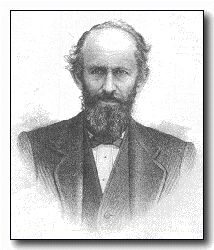
In coming to Michigan the objective point of our
subject had been White Pigeon, this county, where purposed investing in
land. After abandoning his mill enterprise he carried out his first
plan, securing a tract of eighty-seven acres in Constantine Township.
This lay about one mile north of the present village site. He was not in
a condition to settle upon it, and resolved to go to Detroit, whence, if
his health was not better, he would return to New York State. While sick
with the ague at White Pigeon, St. Joseph County, he made the
acquaintance of a Mr. King, who had some means for which he was
seeking profitable investment, Mr. Driggs, whose health was
somewhat improved, went to Bronson Township, Branch County, to look at a
mill site of which he had learned. Here he was joined by Mr. King,
a partnership formed
between them, and the building of the mill begun. Mr. King,
however, later, upon the advice of friends, decided to go further West, and
assigned his interest in the mill property to our subject, giving him two years
to pay for the same. Mr. Driggs, after encountering many
difficulties and hardships, at last was enabled to begin operations in his mill
about the middle of October, 1832. The machinery was run by the old-fashioned
water wheel, and after a few logs had been gotten out, the dam broke, and it was
only by the most superhuman efforts that the mill was saved from being washed
away. For over four months thereafter Mr. Driggs scarcely lost sight of
it day or night, running it eighteen hours out of the twenty-four. There were
then none of the facilities to ship lumber enjoyed by the lumbermen of the
present day, and the whole business proved very expensive, he being able to ship
little besides plank.
In June, 1836, Mr. Driggs sold his mill property
and 400 acres of heavily timbered land for $4,500, and other land for $1,500.
Chicago, Ill., was then but an inferior town, giving no promise whatever of its
future importance. To that place Mr. Driggs journeyed on horseback, but
on his arrival there it appeared to him little more than a mushroom, and he
consequently did not invest any of his capital, returning home with it as he had
started. In the summer of 1836 he applied a portion of it to the purchase of 200
acres of land in Branch and St. Joseph Counties, this State. A few months later
he purchased and built on what is now known as Broad street in Constantine
Township, then a tract of timber land. He cleared a portion of this, putting up
a dwelling and living there until 1862. The year following, there being
indications that Constantine Village might become a desirable place of
residence, he erected a fine dwelling, within which when completed he took up
his abode.
Mr. Driggs had in the meantime invested a
portion of his capital in about 1,600 acres of pine land on Flat River, in
Montcalm County, where he put up a sawmill which he operated about eighteen
years, disposing of the product in Chicago. Prior to this he had purchased a
sawmill, gristmill, a distillery, and a number of town lots southeast of White
Pigeon, on the road to Lima, Ind. He only held this property about three years,
disposing of it then to good advantage. In 1872 he invested in land on Sand
lake, which is slowly but surely becoming valuable.
It will thus be seen that Mr. Driggs has led a
very active life, and he has been for the most part fortunate in his vestments.
After the completion of his residence he erected a brick block in Constantine,
and later purchased the Commercial flouring-mill on Water street, which is
operated by a renter. His example of enterprise and perseverance has proved the
stimulant to many a man who might have retired discouraged from the field in the
absence of a less worthy example. Mr. Driggs during the earlier years of
his life took a very active part in political matters, his sympathies being
uniformly with the Democratic party. For conscientiousness and integrity there
are few who excel him, as is evinced by the expressions of confidence and esteem
which are to be met with on every hand among his fellow-citizens.
After filling many other positions of trust, in which
he acquitted himself in a manner greatly to his credit, our subject was elected
a member of the Michigan Legislature in the fall of 1846, serving his term
acceptably, and in connection with the many measures under discussion, evincing
more than ordinary good judgment and foresight. He represented Constantine
Township in the County Board of Supervisors a period of eleven years, and in
both Branch and this county has officiated as Justice of the Peace. There have
been few interests connected with Constantine and vicinity which have not sought
his counsel, and to which he has ever given a cheerful and attentive hearing.
The status of a community is dependent upon the men who have been the most
prominent during its embryo state, and Mr. Driggs as a pioneer of
Constantine is eminently worthy of record as one of its builders, and associated
with its most important interests.
Miss Frances M. Pease became the wife of our
subject May 29, 1833, the wedding taking place at the home of the bride in
Jackson, Mich. This lady was born in Hampshire County, Mass., Feb. 6, 1811, and
was of excellent old New England stock. Her union with our subject was blessed
by the birth of eight children, four of whom died in infancy. The eldest
daughter, Jane is the wife of C.W. Cord, of Constantine; Charles E., and
Mary live with their father; George, who was a very promising and capable
business man, died in July, 1886, at the age of thirty-six years. Mrs. Frances
M. Driggs departed this life at the home in Constantine, May 3, 1864.
It gives us pleasure to present the accompanying portrait of this honored pioneer,
to whom, as much as to an citizen within its borders, St. Joseph County is indebted
for the development of its industries, which have been the basis of its prosperity.
HENRY PORTER KETCHUM
Henry Porter Ketchum, a well-known resident of
Burr Oak Village, is spending the later years of a well-ordered life in the
quiet and comfort of a pleasant home, surrounded by many friends. His property
embraces thirty acres of highly cultivated land with substantial buildings, and
where he has resided with his excellent wife for a number of years. Mr. Ketchum
was born in the Mohawk Valley, near the town of Glenville, Schenectady Co.,
N.Y., Feb. 8, 1828, and is the son of Chancy and Mary (Wilder) Ketchum, natives
of the same place.
Isaac Ketchum, the paternal grandfather of our
subject, was one of the pioneers of Schenectady County, N.Y., where he engaged
in farming, and spend his last days. Joshua Wilder, the maternal
grandfather, was also an early settler of that locality, a Justice of the Peace,
and a man of note in his community.
Our subject received a common-school education and
learned the trade of carpentry, which he followed in his native county until
1852, and then, a young man of twenty-four years, anxious to see something of
the Great West, made an ocean voyage to the Pacific Coast, and remained in
California about three years. Instead of entering the mines, however, he engaged
in business more certain of returns, as a clerk in various hotels in that
region, to which business he seemed peculiarly adapted, becoming very popular
and drawing a good salary. At the expiration of the time mentioned he returned
to his native State, but soon, however, took up his residence in Weedsport,
N.Y., where during the progress of the Civil War he officiated as "mine
host" of the Mansion House, and where he continued until 1868.
Henry P. Ketchum now set out one more for the
West, and coming to this county settled in Sherman Township, where he employed
himself in farming three years, then embarked in the meat-market business at
Sturgis, where he operated successfully until 1877. Hotel life, however, had
greater charms, and the year following he purchased the Park Hotel at Burr Oak,
which he conducted very successfully for a period of ten years. He was married,
in 1868, to Miss Mary, daughter of James Jones, one of the pioneers of
Oswego County, N.Y., and who was born in 1828.
Mr. and Mrs. Ketchum commenced the journey of
life together in 1868, and have lived harmoniously together for a period of over
twenty years. Providence bestowed upon them no children, but they have gathered
around them hosts of warm friends, and will never suffer for lack of kindly
attention and affection in sickness or in health. Mr. Ketchum has always
been an active member of his community, giving liberally of his time and means
to those enterprises calculated for the best good of the people, socially,
morally and financially.
WILLIAM STEAR
William Stear is a prominent and prosperous
farmer of Constantine Township, where he has cleared and improved as good a farm
as is to be found within the boundaries of St. Joseph County. He is a native of
England, born in Lincolnshire, Jan. 19, 1828. He was reared on a farm in his
native shire, and was there married, July 2, 1850, to Miss Frances Haylock,
who was born in the same shire as himself, a year and a few days later, her
birth occurring Jan. 25, 1829. They continued to reside in their native shire
until the spring of 1861, when they came to America with the five children who
had in the meantime been born to them. They landed at New York and came directly
to Michigan. For three years after that Mr. Stear worked out by the day
in Constantine, and by prudence and wise economy he had saved up enough money to
warrant him in purchasing land and beginning the task of building up a home. He
first bought a tract of forty acres, which is still included in his present
farm. It was then nearly all covered with woods. In the years of toil and
hardship that followed, in which he was aided and encouraged by his wife, he not
only cleared his land from the forest and got it under cultivation, but was
enabled to increase its area by further purchase, until he now owns ninety-three
acres of fertile and highly productive land, and he and his wife have built up a
very pleasant and comfortable home, of which they may well be proud.
The following is recorded of the eleven children born
to Mr. and Mrs. Stear: Maria is the wife of Manford Christian, of
Constantine Township; William lives at home; Mary A. died when about six years
old; Hattie is the wife of Jacob Brandal, of Constantine Village; Charles
lives in Montana; Lizzie is the wife of Andy Craner, of Three Rivers;
Susie, who was the wife of Charles Brokaw, died in Constantine, July 2,
1884; George is a school teacher; Fannie is at home; Robert H. died in infancy,
and Frank is at home.
Mr. and Mrs. Stear are people whose kind hearts
generously respond to any call for aid or sympathy from the unfortunate or
needy, and all such find in them true friends. By their united labors, prudence
and wise management they have obtained a comfortable competence, and can pass
their declining years free from toil and anxious cares that beset their earlier
life. Their many worthy traits of character have gained them the respect and
esteem of all in the community of which they have been members for so many
years. Mr. Stear takes a warm interest in the public affairs of his
adopted country, and votes intelligently with the Republican party, considering
its policy the safest and best in the guidance of National affairs.
SAMUEL VALENTINE
Samuel Valentine, the oldest established grocer
in Sturgis, is one of its representative business men. He has a good store,
neatly fitted up, and carries a large and well-sorted stock, comprising a full
line of groceries, provisions, woodenware, gloves, mittens, tobacco and cigars.
He sells, at reasonable prices, and from his long experience knows well how to
satisfy the demands of his large trade.
Our subject was born in the town of Lysander, Onondaga
Co., N.Y., May 17, 1824. His father, Joseph Valentine, was a native of
Greene County, N.Y., and he there married Mercy Jones, likewise a native
of that county. Six children were born to them, all of whom grew to manhood and
womanhood, but all are now dead but our subject. The father was a farmer and
also a brick mason. He and his wife were people of genuine merit, and were held
in the utmost respect by their neighbors and friends.
Our subject was reared in his native State, and
received a superior education in the Auburn Academy. He started out in life as a
farmer, and was engaged in that calling most of the time until 1854, when he
came to Sturgis. Here he found employment under J.G. Wait, as a
carpenter. He had learned the mason's trade with his brothers, but it did not
suit his taste, so he worked at it only when he could find nothing else to do,
pursuing it for about two years prior to embarking in his present business in
1860. Since that time he has devoted himself entirely to the management of his
store, and has gradually built up a flourishing trade.
Mr. Valentine was married to his first wife Oct.
12, 1848. Her maiden name was Ann E. Howland, a daughter of Humphrey Howland.
Of that marriage three children were born, of whom one, Leonard is, living.
Sarah died in her nineteenth year, and Frank died in his twenty-eighth year.
Mrs. Valentine departed this life in 1861, leaving many warm friends to
mourn their loss, to whom she was endeared by reason of her many excellent
qualities and virtues.
Mr. Valentine was married to his present wife in
1872, and to them one child, Maude, now deceased, has been born. Mrs. Valentine's
maiden name was Jane Jump. She is a thoroughly good woman and is devoted
to the interests of her household. Her parents were Elijah and Charity Jump.
Mr. Valentine has been a resident of Sturgis for
thirty-five years, and he has had an important influence in directing its civic
life, and has held some of its most responsible offices, for which he is well
qualified by education and a natural capacity for affairs. He was City Marshal
for three years; Township Treasurer for one year, and a member of the City
Council for one years, besides having served on the School Board. He holds an
important position in the business circles of this community, his judgment in
regard to business matters being keen and farseeing, and his honesty and
rectitude of character undoubted. He is identified with the Masonic fraternity
as a member of the Burr Oak Lodge.
ALBERT C. FRENCH
A self-made man in the strictest sense of the work, our
subject was early in life thrown upon his own resources, and by his own efforts
has made his way up to a good position, socially and financially, among his
fellow-citizens. A native of Genesee County, N.Y., he was born April 27, 1829,
and was the youngest in a family of five children, three sons and two daughters,
the offspring of Olin and Arethusa (Palmer) French, who were born
in Windsor County, Vt., where they were also reared and married.
The French family after coming to the United
States settled in New England, where they became widely and favorable known as
well-to-do and influential citizens. The parents of our subject upon leaving the
Green Mountain State crossed the St. Lawrence River, and took up their abode in
the township of Hull, Lower Canada, adjacent to the city of Ottawa. Thence a few
years later they returned to the States, and settled in Genesee County, N.Y.
Late they removed to Erie County, and from there, in 1847, to Branch County,
this State, locating in Union City, where they spent the remainder of their
lives. The father, however, only lived until 1854, passing away in the midst of
his usefulness. The mother survived her husband a period of fifteen years,
passing away in 1869.
The subject of this sketch remained a member of the
parental household until a youth of eighteen years, and accompanied his parents
to Michigan. Soon afterward he commenced the struggle of life on his own
account. At the age of twenty-three he commenced the study of medicine in Union
City, under the instruction of the late Dr. William Church, with whom he
remained one year. In the fall of 1852 he entered the office of the late Dr. J.
M. Chase, remaining with him a year also, then going to Rockford,
Winnebago Co., Ill., spent one summer in the office of Dr. Waite, one of
its most eminent and successful physicians.
During the winter of 1854-55 Mr. French attended
lectures at Rush Medical College, Chicago. The spring following he returned to
Mottville. About that time occurred the death of Dr. Chase by accident,
and our subject for a time succeeded to his practice. He finally drifted out of
the medical profession, and turning his attention to mercantile business, was
employed as clerk in a general merchandise store at Mottville. We find him next
established in a book store at Constantine, of which he had the general
supervision, and was thus occupied one years. He then formed a partnership with
Joseph R. Bonebright, and under the firm name of Bonebright & French
they conducted the mercantile business one year together, and at the expiration
of this time Thomas Mitchell was added to the firm. The admission of Mr. Mitchell
brought to them additional business, and there was organized in addition the
firm of T. Mitchell & Co., as operators of the hardware business,
while the general merchandise branch was conducted under the old firm name. The
mercantile career of Mr. French embraces about four years, and upon the
dissolution of the partnerships his time from 1861 to 1864 was spent largely in
closing up the business of the two firms.
In 1864 Mr. French turned his attention to the
lumber trade, and for two years thereafter was in partnership with the late
Isaac Benham. In 1866 he again formed a partnership with his old friend,
Mr. Bonebright, and they operated together until 1884. In 1884 Thomas Mitchell
was admitted as a partner in the lumber business, but in 1886 he withdrew, and
Mr. French now operated the business alone.
Mr. French several years ago wisely invested a
portion of his capital in land, and is now the owner of a fine farm of 120 acres
in Lockport Township, which is conducted by a tenant. In 1861 he put up the
first brick residence in Constantine, a handsome, roomy structure, which not
only makes a very desirable home, but is an ornament to the town. It is built in
the midst of handsome grounds, and there are about it all the indications of
taste and culture for which the proprietor is noted.
The marriage of Albert C. French and Miss Esther
R. Benham took place at the home of the bride in Constantine Village,
April 17, 1758. This lady is the eldest daughter of the late Isaac and Chloe (Case)
Benham. Mrs. French was born in Constantine, Aug. 28, 1836, and is
a lady greatly esteemed in her community, possessing more than ordinary
intelligence and accomplishments.
There are few men in St. Joseph County whose record has
been more creditable or praiseworthy than that of Mr. French. As a
business man he has been active and enterprising, prompt to meet his
obligations, and of the highest integrity. None have taken a warmer interest in
the growth and development of St. Joseph County, and to the various enterprises
tending to this end he has given his uniform encouragement and support. He has
been honored with many positions of trust and responsibility, officiating as
County Recorder and as a member of the Common Council, and occupying the minor
offices. Socially, he belongs to Constantine Chapter No. 61, R. A. M., in which
he has filled all the offices, and for a period of five years was the Master of
Siloam Lodge No. 35, F. & A.M. He also belongs to the Three Rivers
Commandery No. 29, K. T. He is one of the most conscientious supporters of
Democratic principles. A man of decided views, he keeps himself well posted upon
matters of general interest, and is essentially one of those who form the bone
and sinew of a well-regulated community.
HENRY E. ROOT
Henry E. Root, a wealthy resident of Constantine
Village, where he is living in retirement, is well known throughout Southern
Michigan, not only as one of St. Joseph County's most honored citizens, but as a
fine representative of the noble pioneers who have played such an active part in
her development. Coming here in all the strength and pride of early manhood, he
has not only witnessed the gradual giving way before the ax of the pioneer of
the grand old primeval forest that for centuries had covered so much of this
region, and seen large towns and busy villages take the place of the humble log
cabin of the white settlers, or the wigwam of the red man., but he has been an
important factor in bringing about this change, making St. Joseph and adjoining
counties a fruitful and prosperous farming country, where commerce and
manufactures also flourish. To the energy, foresight and enterprise of such men
as our subject, St. Joseph County is indeed greatly indebted for its material
prosperity and high standing. Mr. Root experienced all the privations and
hardships incidental to pioneer life; but difficulties fast disappeared before
his indomitable will and steadfast purpose to make life a success, and old age
drawing nigh finds him well fortified against material misfortune.
Our subject is a worthy descendant of a fine old
Massachusetts family on his father's side, and of sober Connecticut ancestry on
his mother's, and in the ancient town of Pittsfield, in the former State, he
first opened his eyes to this world Dec. 5, 1813. He is a grandson of that
gallant Colonel, Oliver Root, famous in the military annals of the
colonial history of Massachusetts, who born so honorable a part in both the
French and Indian Wars, and in the Revolution. The Colonel was a son of Samuel Root,
and losing his father when he quite young, at the age of eight years was bound
out to Mr. King, of Westfield, Mass., to learn the trade of a shoemaker.
When he was a lad of nearly eighteen years his bold and ardent spirit led him to
enlist in the second French war that was then waging. He had an eventful
experience in his army life, as is recorded in the "Root Genealogical
Records." Arriving at the seat of war the sturdy youth was assigned to
the famous corps of rangers organized by Maj. Robert Rogers, which had
among its officers those men of immortal fame, Gen. John Start, Israel Putnam,
and others of like character, who altogether made one of the most splendid
military companies known in history. When the Revolutionary War broke out, the
Colonel, then in the prime and vigor of a stalwart, athletic manhood,
immediately offered his serviced to the Continental Army, and they were gladly
accepted, and he served with distinction among the many noted Colonial officers.
He was present at the surrender of Burgoyne at Saratoga, in October, 1777. He
was Major of his company under Col. Brown when that officer fell at Stone
Arabis, in the Valley of the Mohawk, and succeeded to the command. He was a man
of fine physique, six feet and one inch in heights, of a robust constitution,
and was never sick in his life until five days before his death. With rare
disinterestedness he refused to apply for a pension, to which he was justly
entitled for the valor and patriotism that he had displayed in his country's
defense while an officer of the Continental Army, on the ground that the act of
Congress could only have been intended for the benefit of those veterans who had
no other means of support, while he was well off. The old warrior is not
peacefully sleeping his last sleep under the sod of the old State he loved so
well, and on his tombstone is inscribed: "He fought the enemies of his
country in two wars, and his only enemies were the enemies of his country."
His son Henry, the father of our subject, was born in
Pittsfield, Mass., Oct. 21, 1783. He was married to Thankful Johnson in
1810. She was born in Haddam, Conn., Oct. 16, 1785. They located in Pittsfield,
where he was actively engaged in farming for many years, and there his venerable
life was brought to a close May 3, 1863, at the age of nearly ninety years. His
wife survived him two years, dying Nov. 30, 1865. During their pleasant wedded
life of over fifty years nine children were born to them, of whom our subject
was the third in order of birth and is now the only survivor.
Our subject passed his early life in Pittsfield on the
old homestead where he was born until he was sixteen years old, when he was
apprenticed to learn the tailor's trade. He served nearly five years, and then
went to Hartford, Conn., where he worked as a journeyman for two years. In 1835
he went to Medina, Medina Co., Ohio, and stopped there until the spring of 1836.
Then, in company with William G. Bagg, he walked through the forests and
swamps of the intervening country to Constantine, arriving here some time in
April. He at once began to work at his trade, and continued at it until the
spring of 1838. When he first came here he entered 200 acres of land in
Constantine and eighty acres in Cass County, and in the spring of 1838 began to
make improvements, and in the following Spring settled on his land in
Constantine. He continued to live there, and actively engaged in the development
of a farm until about 1852, when he returned to the village where he has lived
since, with the exception of one season on his farm. For six years he was
engaged in the butchering business here, but in the spring of 1858 he bought the
hotel then known as the Wells House, but now called the Romaine House, and for
twenty-two years was successfully engaged in its management. In his capacity as
"mine hose" he was a great favorite with the traveling public, as he
was ever frank, genial and obliging in his manners, and his wife, with her
cheerful, motherly presence, added to the popularity of their hotel, and vied
with him in making their guests comfortable. Mr. Root leased his hotel in
1880, and has since lived in retirement, although he still looks after his farm
and other property. Besides the Romaine House he owns 436 acres of very valuable
land, all in Constantine Township. In all his career as a business man Mr. Root
has displayed unusual tact, foresight and ability, and all his transactions have
been conducted with fairness and generosity. He, of course, takes a keen
interest in the affairs of the county and township, with which he has been
identified for so many years, now numbering over half a century, and in whose
upbuilding he has borne an honorable part, and does all that he can to promote
the various schemes for their advancement. Politically, he stands by the
Democratic party as one of its staunchest adherents. More than fifty years ago
our subject was united in marriage in Constantine to Miss Lucinda Beckwith,
April 14, 1837, being the date of their wedding. Mrs. Root was born in
Saybrook, Ashtabula Co., Ohio, Jan. 10, 1816, and was the sixth child in the
family of ten children of the late Levi and Lucinda (Starkweather)
Beckwith, who were born respectively in Pittsfield, Mass., in 1777, and in
Connecticut in 1782. Her parents first settled in Vermont, and then removed to
Ashtabula County, of which they were early pioneers. They subsequently settled
in the township of Saybrook, that county, where Mr. Beckwith bought a
farm, whereon he and his family lived until August, 1828, when they came to St.
Joseph County, this State, arriving at a point on the White Pigeon Prairie, Aug.
6, 1828, and there they settled near the wilderness, they being the fifth family
to locate on that prairie, and Mr. Beckwith sowed the first wheat that
was ever sown on the prairie, on the farm which is now owned by Rodney Beckwith.
They settled in the southern part of Constantine Township, where they continued
to live until death called them hence, the father dying in September, 1839, and
the mother Aug. 10, 1846. The paternal grandparents of Mrs. Root lived to
an advanced age. The marriage of Mr. and Mrs. Root has been blessed to
them by the birth of a family of five children: Henry L.,; Charles O. and Mary
L., deceased; Clarissa A. and Aaron C. Clarissa is the wife of Dr. William E. Jewett,
of Adrian, Mich. Aaron, who is a farmer in Constantine Township, married Anna McGill,
and they have one child, Henry E., Jr. Henry L., the eldest, is unmarried and
lives with his parents, helping his father in the care of his business
interests. He was a soldier in Company A, 49th Massachusetts Infantry (Col. Bartlett
and Cap. I. C. Weller), was severely wounded in front of Port Hudson,
La., and will carry its effects to his grave. He was serving in the store of his
uncle at the breaking out of the Rebellion, and was one of the noted "Allen
Guards" of Pittsfield, Mass., who enlisted in a body and did gallant
service on many a hard-fought field.
DR. JAMES W. BECK
Dr. James W. Beck, dental surgeon, of Sturgis,
is as capable, talented and polar a member of his profession, and as
true-hearted and esteemed a citizen as can be found in St. Joseph County. He was
born in Toledo, Ohio, Dec. 16, 1848, His father, John J. Beck, was of
English birth, the place of his nativity being London, England. About 1830, when
quite young, he came with his parents to the United States, and settled near
Somerset, Ohio. He afterward went to Cincinnati, and was for many years employed
as bookkeeper for an auction commission firm. He thence removed to Toledo, and
in 1854 to Hudson, Mich., where he lived until 1865, when he came with his
family to Sturgis. He was a man of sterling worth, universally respected for his
integrity and upright business transactions, and was for twenty-one years
cashier of the Sturgis National Bank. His wife, whom he married while residing
in Toledo, died in May, 1886, and he, resigning his position in the bank, went
with his daughter to San Francisco, dying there in June, 1888.
Our subject passed his early life in Toledo, and after
coming to Michigan completed the regular course of study at the High School at
Hudson. In 1870 he established himself as a dentist in Monroe, this State, where
he met with much success, continuing there four years. In 1874 Dr. Beck
opened an office in Sturgis, and has here built up an extensive and lucrative
practice, his competency in all branches of his vocation having won him a large
patronage, customers who have once had the benefit of his skill and experience
being sure to call upon him for any further needed dental work.
Dr. Beck was united in marriage, Nov. 7, 1883,
To Miss Mima, daughter of Thomas Naylor, of Middlebury, Ind. Of their
union one child has been born, a bright and interesting little daughter named
Ethel.
Our subject takes an active interest in the growth and
prosperity of this community, aiding all schemes for its improvement, and has
served faithfully as Village Clerk three terms, as Township Clerk one term and
has been School Inspector two years. Both Dr. and Mrs. Beck are valued
members of society, and have the good wishes of a host of friends and
acquaintances.
HON. JONATHAN G. WAIT
Hon. Jonathan G. Wait, a prominent resident of
the city of Sturgis, came to this region during its Territorial days, in 1834.
He was then a young man twenty-three years of age, having been born in
Livingston County, N.Y., Nov. 22, 1811. Nature endowed him with fine capacities
and a resolute will, and from the foot of the ladder in life he has risen to an
enviable position among his fellowmen.
Josiah and Ann (Graham) Wait, the parents
of our subject, were both natives of the town of Amstead, N.H., whence they
removed after their marriage to the vicinity of Ovid, in Livingston County, N.Y.
Later they changed their residence to Perry, Lake Co., Ohio, where they lived a
number of years, and then removed to LaPorte County, Ind.
The patronymic of our subject has been spelled in
several different fashions, namely: Waite, Wayte, Wayght, Waight, Wait, Waitt,
Watt, Weight and Waiet. It has been traced back as far as 1075, to William
the Conqueror, who gave the earldom, city and castle of Norway to Ralph D. Waiet,
who was the son of an Englishman by a Welsh woman, and who married Emma, a
cousin of the Conqueror. Among their descendants were Richard, John and Thomas,
who were among the earliest settlers of New England. Thomas was the father of
Josiah and the grandfather of our subject, Jonathan G. Wait. Reared upon
the farm and educated in the common schools, our subject at the age of
seventeen, being a bright and ambitious youth, commenced teaching in the
district school, which occupation he followed at intervals for several years.
After a brief sojourn upon his first visit to this State he went back to Ohio,
but returned the following year and located on Sturgis prairie, where he
commenced to till the soil and build up a homestead. He has since occupied the
land which he secured, and has village property where he erected four houses the
first year, and about 100 since, owning twelve business houses in Sturgis at
this time. He soon began the manufacture of boots and shoes, and at the same
time carried on a cabinet and chair manufactory, giving employment to ten or
fifteen hands. This was before the days of machinery, and this business was
conducted a period of fifteen years. Subsequently Mr. Wait became
interested in the manufacture of lumber, and in 1850 was in the employ of the
Michigan Southern Railroad Company, not only in procuring the right of way for
the projected road, but taking heavy contracts in the building of fences and
depots.
The enterprise and energy of Mr. Wait obtained
due recognition by the people of this county, and in the fall of 1850 he was
chosen by the Whigs as their representative in the General Assembly. He served
during the administration of Gov. Barry, at which time occurred the great
contest between the Michigan Central & Michigan Southern Railroads, the
latter coming out victorious. In 1857 Mr. Wait helped to organize the
Grand Rapids & Indiana Railroad Company, being elected a Director thereof, a
position which he has held to the present time. During that year he
superintended the grading and bridging of twelve miles of this road. In 1860 he
was elected to the State Senate, serving satisfactorily, and re-elected two
successive terms, during which time he had charge of many important matters,
including the bills for the extension of the time for constructing the Grand
Rapids & Indiana Railway. This was then considered a very important project,
especially to the people of Sherman, Burr Oak, Fawn River and Sturgis Township.
Previous to this Mr. Wait had served as Township Clerk, Supervisor, and
Justice of the Peace many years. In fact his whole life has been largely devoted
to public duties, in the discharge of which he had acquitted himself in a
conscientious and praiseworthy manner.
Mr. Wait when nearly twenty-eight years of age
was wedded, Oct. 20, 1839, to Miss Susan S., daughter of George and Mary (Hershey)
Buck. This lady was born in Erie County, N.Y., Jan. 8, 1821. Her parents,
natives of Erie County, Pa., emigrated to Michigan during the days of its
earliest settlement, in 1828. The father was a farmer by occupation, and built
up a good homestead from the wilderness of Sturgis Township, this county. Their
family consisted of seven children, three of whom are living.
To our subject and his estimable wife there have been
born the following children: William H., April 25, 1842; Daniel G., March 24,
1844; George, June 18, 1846; Mary E., Sept 28, 1847; Thaddeus P., Dec. 28, 1849;
Arthur H., April 2, 1851; Jay G., Aug. 1, 1854; Jessie, Oct. 14, 1856; Frank W.,
Dec. 22, 1858; Lee E., July 22, 1861, and Henry. Thaddeus adopted the profession
of aw, entering upon the practice of his profession at Sturgis; he died in
California.
Mr. Wait was reared in the doctrines of the
Baptist Church. Politically, he votes the straight Republican ticket, and
energetically supports the principles of his party. He established the Sturgis
Journal in 1860, and continued to run the same until 1875. Mr. Wait
is, and has been for a number of years, very extensively engaged in the
mercantile business, and kept four peddling wagons on the road for several
years.
JOHN M. HUFFMAN
John M. Huffman has been a resident of St.
Joseph County for forty years, and until his retirement from the active cares of
life to his present home on section 23, just outside the corporate limits of the
village of Constantine, was connected with its agricultural interests. He was a
practical, skillful farmer, and worked his farm in Park Township to such good
advantage that he gained a comfortable competence, and can now pass his
remaining years without the necessity of hard labor.
Our subject comes of good Pennsylvania stock. His
parents, Samuel and Polly (Jones) Huffman, were both natives of
the Keystone State, and there spent their whole lives, dying in Clarion County.
The father was a substantial farmer, and he and his wife were held in general
esteem by those who knew them for their many solid virtues. They had a family of
nine children, of whom our subject was the fourth in order of birth.
Mr. Huffman was born June 22, 1824, in Clarion
County, Pa., and there on the old homestead grew to sturdy manhood. He was
reared to the life of a farmer, and remained an inmate of the parental home,
affording his father active assistance in the management of his agricultural
affairs until 1849. He was then twenty-five years old, and had obtained a good
start in life, so he determined to try farming in Michigan, and build up a home
here. With that end in view he came to St. Joseph County, and settled in Fabius
Township. A few years later he removed to Park Township, of which he remained a
resident for twenty-eight years. He became the possessor of a farm there,
comprising eighty acres of as fertile and productive land as is to be found in
the limits of the county. This, by careful cultivation and constantly added
improvements, he greatly increased in value, and it was classed among the fine
farms of the township, and when he desired to retire from active labor he no
difficulty in disposing of it at a good price. In May, 1885, he sold all of his
property in Park Township and came to this village, where he owns a small place,
to spend his declining years in retirement.
Mr. Huffman has been three times married. His
first marriage, which took place in Clarion County, Pa., was to Lucinda Briggs.
By her he had two children; Margaret, who is the wife of Emanuel Strome,
and Dorsey, who is a resident of Muskegon. Mrs. Huffman's wedded life was
of brief duration, as she died while yet young, in Fabius Township, April 19,
1854. The second marriage of our subject was to Elizabeth Miller, and the
following is the record of the four children born to them: Effie is the wife of
Emanuel Eichholtz; Samuel died when about two and one-half years old; Ada
lives at home with her father, and Charles died in infancy. Mr. Huffman's second
wife died in Park Township, June 9, 1877, and he was again married, June 21,
1878, being then united to Mrs. Louisa Richmond, his present wife. She
was born in Tioga County, N.Y., March 16, 1830. She has also been three times
married. Her first husband was Josiah N. Fisher, who died in Ligonier,
Ind. By that marriage she had five children, as follows: Eliza O., who is the
wife of Lewis H. Bossett; Frank lives in Three Rivers; Albert lives in
Denver, Col.; Fred lives in Lansing, Mich., and Alva J. lives in Chicago, Ill.
Mrs. Huffman's second marriage was to John Richmond, who died in Ohio.
One daughter was born of that marriage, Minnie R., who is the wife of Thomas J. Keene.
Mrs. Huffman is a devoted member of the Baptist Church, and her daily
life is guided by the highest Christian principles. Mrs Huffman's maiden name
was Louisa Tracy, and she is the daughter of Erastus and Eliza (Arnold)
Tracy, natives respectively of Massachusetts and Unadilla, N.Y. After marriage
her parents settled in Tioga County, N.Y., and thence subsequently came to St.
Joseph County, this State. They settled in Constantine, where he died in June,
1884. Mrs. Huffman's mother still survives, at an advanced age. They were
among the earliest settlers of this county. They had nine children, of whom Mrs.
Huffman was the second, as follows: James, Louisa, Romelia, Mary, Martha;
Levi and Lavina, twins; Walter B. and John.
Mr. Huffman, although not among the early
settlers of St. Joseph County, has some claim to be classed among its pioneers,
as in improving his farm he did his share in developing and strengthening the
great agricultural interests of this part of Southern Michigan. He stands high
among his neighbors as a man of truthful, honest, kindly nature, and one on whom
they can rely for friendly aid or wise counsel. In his political sentiments he
is a sound Republican, giving staunch support to his party.
JOSEPH B. CATTON
Joseph B. Catton, a retired farmer living
pleasantly and comfortable in Constantine Village, has been a witness of almost
the entire growth of St. Joseph County, from the primeval, forest covered land
of more than half a century ago to its present advanced state as a wealthy
agricultural region, where commerce and manufactures also flourish, as in 1833,
when he was nine years of age, his parents, John and Mary (Barnard) Catton,
came to this county and east in their lot with the earliest pioneers of Southern
Michigan, and with the exception of a few years he has been a resident here ever
since. He was for a long time subsequent to attaining manhood actively
identified with the agricultural interests of the county, and still owns a
valuable farm of 200 acres in Constantine Township. He has therefore been a
factor in developing the county, and as such we are glad to represent him in
this biographical work, where the record of so many of St. Joseph County's
pioneers and leading men is preserved for the edification of the present and
coming generations.
The parents of our subject were natives of Yorkshire,
England, and there grew to maturity and married. In 1832, determining to avail
themselves of the numerous advantages that the United States of American
presented over the mother county, they emigrated with their family of five sons
and three daughters to these hospitable shores, and for awhile lived in the
State of New York. The following year they came to St. Joseph County and settled
in White Pigeon Township, of which they thus early became pioneers. They lived
there for many years, and patiently endured the discomforts and even hardships
of life in a newly settled country. They afterward spent seven years in Indiana,
but returned to this State and settled once more in St. Joseph County, and
finally passed to the home beyond the grave from their earthly home in
Constantine Township.
He of whom we write was the youngest child of those
worthy people, and is now the only surviving member of the family. He was born
in Yorkshire, England, Aug. 12, 1824, and was quite young when he accompanied
his parents across the Atlantic to make his home in the future on this
continent, and as time passed on to become a respected citizen of one of the
great commonwealths forming the United States. He lived with his parents until
their death, including seven years' residence in Indiana. In 1852 he was smitten
with the eager thirst for gold that sent so many of our countrymen and the
people of other nationalities flocking across the great plains and over the
Rocky Mountains to California, to seek for the precious metal. Two years he
spent mining in that State, and his hard toil met with due reward, and at the
end of that time he returned to St. Joseph County, well satisfied with his
gains, to settle down in life. He turned his attention to farming in Constantine
Township, and was so successful in his venture that in November, 1886, he
retired to his present home, to enjoy the present competence that he had won by
honest and untiring industry, and now lives very quietly, surrounded by all the
comforts that heart could wish.
Mr. Catton was married in Mottville township,
Jan. 1, 1855, to Mrs. Elmira Shellenberger, daughter of Tobias and
Catherine Hassenger. Her parents came to St. Joseph County in 1846, and
settled in the western part of Constantine Township, where the father died Jan.
8, 1874, when he was within three weeks of being sixty-two years of age. She
died on the 11th of December, 1888, lacking but a few weeks of completing her
eighty-first years. Both were natives of Allegheny County, Pa., and both when
young emigrated to Richland County, Ohio, where they were married. They removed
to Wood County, Ohio, and later to St. Joseph County, Mich., settling upon a
farm in the western part of Constantine Township, in which place they lived
until the death of the father, after which the mother removed to the residence
of her youngest daughter in Constantine Township, where her death occurred. Mr.
and Mrs. Hassenger were the parents of eleven children, three daughters
and eight sons, and Mrs. Catton was their third child in order of birth.
She was born in Richland County, Ohio, Aug. 7, 1832.
Mr. and Mrs. Catton have had four children, of
whom the following is recorded: Mary E., is the wife of Morris Hayman;
George F. is married to Lutie, daughter of William and Ruth Simmons, has
two children, and lives on his father's farm in Constantine Township; Willie
died in infancy, and Henry B. is a teacher in Constantine Township.
Mr. Catton is in every sense of the phrase a
good man. He has been industrious and thrifty, and always dealing fairly and
squarely with his fellowmen, deserves that prosperity should smile on him. In
his wife Mr. Catton secured a true helpmate, one who is a judicious and
capable manager, who has actively co-operated with him in his work, and has
never neglected the comfort of her household. She and her husband are true
Christians and are esteemed members of the Reformed Church, of which he is an
Elder. They are very pleasant, amiable people, whom to know is to like. Mr. Catton
interests himself in the political affairs of the Nation, and warmly espouses
the cause of the Democratic party.
ADAM GENTZLER
In reviewing the career of this gentleman, we must
admit that the lines have apparently fallen to him in pleasant places. Of a
temperament genial, pleasant and companionable, he is a man who at once secures
the confidence and esteem of those good fortune it is to make his acquaintance.
He is a universal favorite in the social and business circles of Constantine,
and occupies a well-appointed home on section 11. He has a comfortable dwelling,
a particularly good barn, and the other outbuildings necessary for the modern
agriculturist, and has gathered around him all of the comforts and many of the
luxuries of life. Generous and public-spirited, he has not thought alone of his
own interests, but as he has had opportunity has uniformly labored for the best
interests of his community. The example of such a man is everywhere felt, and is
untold in its result.
The Gentzler family came originally from
Wurtemberg, Germany. The first emigrant came here with his wife prior to the
Revolution. He was, we believe, named Conrad, and was the great-grandfather of
our subject. He enlisted in the Continental Army, and served seven years, or
during the entire struggle for independence. On receiving his discharge, and
being about to set out for his home, he was shot and instantly killed, by
mistake of a sentinel. He left a wife and three sons at his home in York County,
Pa. His widow again married, and lived to an extreme old age, being past ninety
at the time of her death. Of the sons, Philip lived and died in York County, Pa;
he lived to be ninety-four years old, and was father to fourteen children.
Conrad removed to McConnellsville, Pa., where he owned a hotel. He is supposed
to have taken part in Shay's rebellion, as about that time he disappeared, and
his property was never claimed.
George Gentzler, grandfather of Adam, was the
youngest son. He was born shortly after his father entered the patriot army,
probably in the latter part of 1776 or 1777, in York County, Pa. He worked at
shoemaking, but after his marriage because a farmer, settling in Washington
Township, in his native county. He was successful in his chosen vocation, and
accumulated considerable property. He died of cancer, in his sixty-fifth year.
His wife was Margaret Law, also a native of York County. She survived her
husband many years, emigrating to Michigan with her son Jacob, and dying at
White Pigeon in 1857, aged eighty-four. Jacob was the only child of George and
Margaret Gentzler, and was born in Washington Township, York Co., Pa.,
Dec. 16, 1798. He was married to Elizabeth Speck, Oct. 14, 1819. She was
born in Lancaster County, Pa., Jan. 14, 1800. After a few years' sojourn in
their native State, they gathered together their personal effects and made their
way to the young and growing State of Michigan. Coming to this county in 1849,
the father first settled on a tract of land in White Pigeon Township, but later
they removed to Florence Township, where they spent the remainder of their
lives. Jacob Gentzler looked his last upon the scenes of earth at the old
homestead, May 16, 1871. The mother survived her husband twelve years, dying
June 20, 1883.
To the parents of our subject there were born eleven
children, as follows: Margaret was twice married, first to Peter Stickle,
of York County, Pa., and after his death to John Alvey, of Florence
Township, this county; George died at his farm in Park Township; Martin was
accidentally scalded to death in childhood; John was killed at the age of
sixteen, by the kick of a colt; Elizabeth died in Kansas, where she had removed
with her husband, Richard Stokes. The survivors of the family are:
Catherine, widow of Leonard Kapp, of Fabius Township; Adam was next;
William, unmarried, is a resident of Nottawa Township; Mary Ann is the wife of
Solomon Chronister, of Florence Township; of Jacob a sketch is given
elsewhere; Sarah A. lives in Nottawa Township and is the wife of Henry Limbach,
formerly Treasurer of St. Joseph County. Adam Gentzler, our subject, was
born in Washington Township, York Co., Pa., July 12, 1827. His childhood and
youth were spent amid the quiet pursuits of farm life, but when approaching
manhood, like many of that age, desirous of a change, engaged in a woolen-mill
for a period of four years. Aside from this he has been engaged in farming all
his life. He remained a resident of his native county until coming to Michigan
in April, 1853, joining his parents after they had resided here a period of four
years. He had then been married, and now took up a tract of land in Park
Township, upon which he operated twelve years, then removed to Constantine
Township, of which he has since been a resident.
Mr. Gentzler was married in Carroll Township,
York Co., Pa., July 12, 1849, to Miss Lydia A. Lehmer, who was born there
Feb. 19, 1828. Mrs. Gentzler is the daughter of John and Susannah (Fickes)
Lehmer, who were native of York county, Pa., and spent their last days in this
county, both dying in Constantine. This lady became the mother of five children,
and departed this life at the homestead in Constantine Township, Aug. 18, 1885.
Their eldest son, Jacob L., is farming on his own land not far from the
homestead; Susan died in infancy; John R. is a resident of Florence Township;
Elizabeth N. married George W. Hamilton, of Constantine; Mary E. became
the wife of B. H. Sevison, and died at her home in Florence Township, in
August, 1880.
Our subject has been a member of the Evangelical
Lutheran Church a period of forty-five years, his parents and grandparents
having also long been members of the same church. Of this church his estimable
wife was also an adherent for many years before her death. She was a good woman
in the broadest sense of the term, benevolent and charitable, and was connected
with the Ladies' Aid Society. Mr. Gentzler attained his majority in his
native State, and cast his first Presidential vote for Lewis Cass. He has
ever since been a staunch supporter of the Democratic party. While a resident of
Park Township he was a member of the School Board, and held the offices of
Justice of the Peace and Highway Commissioner. He is of a retiring disposition,
however, in nowise anxious for the responsibilities of public life, preferring
to give his attention to his farm and his fireside. Of late years he has turned
his attention largely to stock-raising, also buying and shipping. His farm
embraces 193 acres of good land, which has been brought to a thorough state of
cultivation, and is valued at a good round sum.
THOMAS CUDDY
A community of enterprising men soon leave their mark
upon the section of country wherein they settle, and to them it is indebted for
its growth and prosperity. In order to affect this they must be liberal-minded,
progressive and unselfish. Nottawa Township has been fortunate in this respect,
and among the men who have aided in her growth and prosperity the subject of
this sketch occupies a leading position. Not the least among his labors have
been the building of a fine homestead, the cultivation of the soil, the planting
of trees, the building of fences, and last, but not least, the erection of neat
and substantial farm buildings. These include a handsome and commodious brick
residence, while the barn and other structures for the storing of grain and the
shelter of stock indicate the enterprise of the proprietor.
A large proportion of the early settlers of Michigan
owe their birth and ancestry to a foreign land. The childhood home of Mr. CUDDY
was in County Tyrone, Ireland, where his birth took place in 1829. His father
was a farmer by occupation, and the boy grew up with limited advantages, but
with sentiments of honesty and habits of industry. He was bright and ambitious,
and when twenty years of age resolved to seek his fortunes on the other side of
the Atlantic. Taking passage on a sailing vessel at Liverpool, he landed five
weeks later upon American soil, in the city of New York.
Young CUDDY soon made his way to the State of
Michigan, and having in view the pursuits of farm life, located, in the month of
June, upon a tract of land in Nottawa Township, near the river. He lived for a
time with an uncle, not having yet formed matrimonial or domestic ties. He
proceeded with the cultivation of his land, remaining a bachelor for a period of
nearly ten years longer, but on the 28th of April, 1859, was united in marriage
with Miss Catherine McKINLEY.
The wife of our subject is the daughter of Robert and
Catherine McKINLEY, who were natives of Scotland, and settled in Sherman
Township, this county, during its pioneer days. The father followed the peaceful
pursuits of farm life, and died in 1883. The mother departed this life Jan.
28,1875. Mrs. Catherine CUDDY became the mother of three children, and
departed this life at the residence of her father in Sherman Township, on the
4th of September, 1869, at the age of twenty-seven years, having been born in
1842. Her native place was Amsterdam, N.Y. The children of this union were
Catherine L., Robert J., and Samuel. The latter died when about eight years of
age. The others are living.
Mr. CUDDY, on the 28th of September, 1871,
contracted a second marriage with Miss Catherine CULBERTSON, who was born
in Pennsylvania, in 1837. She was the daughter of James CULBERTSON, one
of the early pioneers of this county, and died at her home in Nottawa Township,
Aug. 24, 1878.
The present wife of our subject, to whom he was married
March 3, 1880, was formerly Miss Ella PLATT, daughter of Henry and Lydia PLATT,
of Leonidas Township. Henry PLATT was also one of the pioneers of this
county. He and his excellent wife were natives of New York; the mother died in
1872, and the father is still living. Miss Ella CUDDY was born in 1859,
in Leonidas Township, and was the second child of her parents, whose family
consisted of two children. Of her marriage with our subject there have been born
a daughter and two sons-Jennie L., George L. and Thomas T.
Mr. CUDDY, upon becoming a naturalized citizen,
identified himself with the Democratic party, and cast his first Presidential
vote for Pierce. Later he considered that he had reason to support the
Greenbackers, and accordingly allied himself with them. He has never been an
office-seeker, but prefers to give his strict attention to his own affairs.
JOHN RUTHERFORD
The men who came to Michigan in the pioneer days and
inaugurated the struggle with the primitive soil, battling with the first
difficulties with life in a new country, deserve more than passing mention. It
must have required no small amount of courage and perseverance to break loose
from old friends and associations, and perhaps with no other means than stout
muscles and a hopeful heart, enter upon the task of opening up a homestead from
the wilderness, a task which they understood from the first would involve years
of labor and no small outlay of capital. Among the men who thus distinguished
themselves in this county is the subject of this sketch.
Mr. RUTHERFORD was born in Caledonia, Livingston
Co., N.Y., June 26, 1814, and lived there at his father's farm until a youth of
nineteen years. Then, learning the carpenter trade he worked a year as a
journeyman in his native State, and at the end of this time, resolving upon a
change of location, made his way to the Territory of Michigan. Early in the
spring of 1836, still unmarried, he migrated to this county, and employed
himself as a farm laborer about two years, mostly in Nottawa Township. He had in
the meantime purchased 160 acres of land in Allegan County, which he now sold,
and invested a portion of his capital in 130 acres just east of Centreville in
Nottawa Township, which he occupied and cultivated a period of seven years. He
had now practically abandoned his trade and given his attention to the more
congenial pursuits of agriculture. At the expiration of the time mentioned Mr. RUTHERFORD
sold out again, and purchased 200 acres on section 29 in Nottawa Township, which
comprises his present farm. The history of those first few years is similar to
that of his brother pioneers, and during which he labored early and late,
enduring many privations and sacrifices for the sake of future good to himself
and family. Although for the most part successful he has had his adversities and
losses, having in April, 1862, suffered the loss of a fine residence, which was
destroyed by fire. He at once rebuilt, and in due time found himself on his feet
again.
The greater portion of the Rutherford farm is under a
fine state of cultivation. Our subject has a fair assortment of livestock, an
ample supply of choice fruit, and all the other necessaries conducive to his
comfort and well being. He was united in marriage with Miss Betsey Ann ENGLE,
in Nottawa Township, March 4, 1838. Mrs. Betsey A. RUTHERFORD, also a
native of New York State, was born in Mt. Morris, Livingston County, in 1818.
This lady became the mother of two children, and died at the homestead in
Nottawa Township in November, 1874. Their elder child, a son, George W., remains
with his father at home; he married Miss Ellen ASHLEY, a native of Oswego
County, N.Y., and they have two children, John A. and Zoe E. Isabell J. is the
wife of Francis GOODEN, of Nottawa.
Our subject contracted a second marriage in January,
1881, with Miss Sarah GEE, also a native of the Empire State, and born in
New York in 1812; she died in the year 1888. Her parents were natives of New
York State, and are now deceased. Mr. R. has been quite prominent in local
affairs, representing Nottawa Township about twelve years in the County Board of
Supervisors, officiating as Justice of the Peace the same length of time, and
serving as Highway Commissioner at different times for the last twenty years. In
religious matters he adheres to the doctrines of the Reformed Church.
The RUTHERFORD family is Scotch ancestry as far
back as the records have been preserved. James RUTHERFORD, the father of
our subject, was a native of Edinburgh, the Scotland, and married a maiden of
his own Province, Miss Mary HUNTER. They came on a bridal tour of United
States, settling in Livingston County, N.Y., where the father engaged in
farming, where all their children, nine in number, were born, and where the
parents spent the remainder of their lives. John was the fifth in order of
birth. In the early days the pioneer farmers during harvest time fortified their
harvest hands with generous supply of whisky. The father of our subject
discontinued this practice when John was a lad of fourteen years, and became a
strict advocate of temperance. He succeeded in training his sons to his way of
thinking, especially John, who is now a pronounced Prohibitionist, although he
still casts his vote with the Republican party.
STEPHEN M. SNYDER
Stephen M SNYDER is a native-born citizen of
Michigan, Lockport, St. Joseph County, being his place of birth, and May 18,
1843, the date thereof. He is now prominently identified with the agricultural
interests of his native State, owning and occupying a fine farm on section 1,
Fabius Township. He is a representative of an honored pioneer family of St.
Joseph County, his parents, Henry and Lydia (MOORE) SNYDER, being
among the early settlers of Southern Michigan. They were natives of
Pennsylvania, his father being born in what is now Snyder County, in 1804, and
his mother in Union County that State.
Our subject obtained a fair education in the common
schools, and was reared to man's estate on his father's farm, having no
recollection of being out of the county until he entered the army. The breaking
out of the Rebellion found him a strong, active, self-reliant lad, capable of
doing his full share of labor on the home farm. He watched the progress of the
war with intense interest, and ardently and patriotically desired to go to the
assistance of his country. His wishes were finally gratified, and Aug. 15, 1862,
before he had attained his majority, he was enrolled as a member or the gallant
25th Michigan Infantry. In the three years that followed he experienced all the
dangers and hardships of war on many a hard-fought battlefield, in many a weary
march, and in malarious, unhealthy camps, oftentimes without proper food and
with insufficient shelter. He bore up bravely under all these discouragements
and sufferings, and proved himself to be a good soldier, on upon whom his
officers could rely. He took part in the battles of Resaca, Rocky Face, Etowah
River, Kingston, Altoona, Pine Mountain, Lost Mountain, Culp's Farm, Kenesaw
Mountain, Chattahoochee River, Decatur, Atlanta, Rome (Ga.), Cedar Bluff and
Nashville, and in many minor battles and skirmishes.
After his retirement from the army Mr. SNYDER
farmed with his father until the year 1868, when he went to Iowa to dispose of
some land which he owned there, and after completing his business, visited
Kansas and other Western States. After his return home he married, Feb. 7, 1869,
to Miss Utica E. STUCK, daughter of Jacob and Rebecca (SNYDER) STUCK,
of Indiana. Her parents were of Pennsylvania origin and of German descent, and
she was likewise a native of Pennsylvania, born in Snyder County, Dec. 9, 1847.
While to Mr. and Mrs. SNYDER have been vouchsafed the joys of parentage,
they have also suffered its sorrows in an uncommon degree, as five bright and
promising children of the seven born to them have early passed away from the
sins of sorrows of this life
"And to all the evil that's in the world
They will know no waking."
They have two children living: Willis C., born April 9,
1871, and Alvin J., Sept. 20, 1875. The record of the others is as follows:
Charles E., born May 27, 1873, died Sept. 22, 1882; John M., born Nov.7, 1877,
died March 12, 1879; Clarence H., born Nov. 17, 1879, died April 26, 1881; an
infant who died unnamed; Lydia R., born April 25, 1886, died Sept. 11, 1887. Mr.
SNYDER settled on his present farm in 1887, and has since much improved
it.
Our subject is a man of strong, earnest, manly
character, combining firmness with such a genial and kindly disposition as to
win the regard as well as the respect of his neighbors. He and his good wife,
who is held in equal esteem, are leading members of the Reformed Church, he
holding the office of Deacon in the congregation at Three Rivers. Mr. SNYDER
has been a stanch Republican ever since he was old enough to vote, and he is
also a strict Prohibitionist. He takes an active interest in educational
matters, and is giving his children the benefit of the superior educational
advantages of his and their native State.
STEPHEN SHOWERMAN
The farm property of the subject of this sketch
occupies eighty acres on section 27, in Nottawa Township, and forms one of the
well-regulated homesteads of this county. The proprietor is a native of
Deerfield, Madison Co., N.Y., and was born Dec. 31, 1819. When but a lad his
parents removed to Genesee County, where he was reared to manhood and lived
until the fall of 1853. He had been married in the meantime, and now decided to
seek his fortunes in the State of Michigan. He accordingly disposed of his
property interests in the Empire State, and came to this county. He settled at
once in Nottawa Township, of which he has since been a resident. He has eighty
acres of land, good buildings, and his industry has gathered around him a large
portion of the good things in life.
William SHOWERMAN, the father of our subject,
was born near the city of Albany, N.Y., and married Miss Susan LAMPMAN,
who was also a native of that State. They settled in Genesee County, where they
spent the remainder of their lives, engaged in farming pursuits. The household
circle included twelve children, all of whom lived to mature years. Stephen at
an early period in his life became familiar with agricultural pursuits, and has
been content to make these his vocation. He was first married in Oakfield,
Genesee Co., N.Y., in October, 1853, to Miss Adela MUNGER, who was a
native of that county, and who became the mother of one child, a son, Seymour,
who is now on Ionia, Mich., Mrs. Adela SHOWERMAN died at the homestead in
this county, in 1856, two and one-half years after coming to the West.
Mrs. Lucinda (ELLSWORTH) KNICKERBOCKER
became the second wife of our subject April 21, 1858, the marriage taking place
at the home of the bride in Burr Oak Township. This lady was born in Manlius,
N.Y., Feb. 26, 1834, and is the daughter of Ira and Sophia (EATON) ELLSWORTH,
who were natives of Vermont and New York respectively, and who passed the
greater part of their lives in this State. They are now deceased.
Mrs. SHOWERMAN spent her childhood and youth in
Mosherville, this State, receiving a common-school education, and was married in
1849 to James KNICKERBOCKER, who was a clothier and teacher by
occupation, and died in Colon Village, June 15, 1857. Of this marriage there
were born three children, a son and two daughters-EDGAR, Ida H. and
Carrie V. EDGAR is a carpenter at Lansing; Ida is the wife of Albert DECKER,
of Big Rapids; Carrie, Mrs. Charles SMITH, resides in Grand Rapids. Of
the marriage with our subject Mrs. SHOWERMAN has four children, namely:
Nettie S., Lottie M., Roy E. and Ralph W. Nettie is the wife of Albert THOMAS,
of Greenville, this State, and Lottie married George DAVIS, of Nottawa
Township.
Mrs. SHOWERMAN is a lady of fine capabilities
and more than ordinary intelligence, a lover of books, and a mother looking
carefully after the mental training of her children. She has hosts of friends in
her community who speak of her in the highest terms. She has for many years
carried on the business of dressmaking, numbering among her patrons the first
ladies of the township.
JESSE NERHOOT
Among the farmers and stock-raisers of Fabius Township
none are meeting with more deserved success than the subject of our sketch. He
owns good farm on section 3, which is under high cultivation, is well stocked,
and is amply provided with necessary buildings and machinery for properly
carrying on agriculture.
Mr. NERHOOT was born in Union County, now Snyder
County, Pa., March 7, 1824. His parents were Michael and Catherine (LONG)
NERHOOT, natives of Pennsylvania, the father of German ancestry and the
mother of English.
Our subject received a good practical training as a
farmer in his youthful days, and remained at home to assist his father in the
labors of the farm until his marriage to Catherine KNITLE, which took
place July 16,1844. She was born Sept. 2, 1824, in Pennsylvania, her parents
being Henry and Sarah (ZIMMERMAN) KNITLE, also natives of the
Keystone State. Mrs. NERHOOT is an excellent housewife, and has been a
true helpmate to her husband, heartily co-operating with him in his labors to
build up the comfortable home in which they are now passing the declining years
of a life well spent, in the enjoyment of the competence which they gathered
together in their busy years, thoroughly respected and trusted by all around
them. Our subject experienced some of the hardship and sufferings of war, as he
was drafted during the late Rebellion, and faithfully served as a soldier for
nine months, being a member of the 172d Pennsylvania Infantry and Heavy
Artillery.
In 1864 our subject and his family bade farewell to
their friends and their old home in Pennsylvania and moved to Erie County, Ohio.
Mr. NERHOOT was employed on a farm there for one year, when he again made
a move, and in 1865 we find him with his wife and children in Sandusky County,
in the same State, where he bought thirty-five acres of land, which he tilled
with commendable industry and good success for twelve years. During that time he
was also employed as a carpenter. In 1877 he wound up his affairs in Ohio, and
crossed the border into Michigan, where he bought eighty acres of land in Fabius
Township, St. Joseph County, which is still included in his present farm. Mr. NERHOOT
has been prosperous in his farming ventures since coming to St. Joseph County,
and at one time owned land to the amount of 160 acres; he has since disposed of
a part of it at a good profit on his original investment.
Our subject and his wife have had eight children seven
of whom are living, of whom the following is recorded: Henry, born Nov. 2, 1845,
lives in Kansas, is married and has several children; Catherine died in infancy;
Sarah, born Dec. 30, 1850, married Henry MOYER, and lives in Ohio; Susan,
born April 7, 1853, married James FREDRICK, a farmer of Fabius Township;
Jane L., born June 3, 1855, married Albert AVERY, of Fabius Township;
George M., born Jan. 15, 1858, in Pennsylvania, lives at home with his parents;
Caleb, born March 17, 1860, lives on the homestead, is married and has one
child; Melia E., born )ct. 6, 1864, married Levi WETHERBEE, of Fabius
Township, and they have two children.
Mr. NERHOOT is an observant, intelligent man,
well informed in regard to the news of the day. He was the seventh in a family
of ten children but his parents were enabled to give him the benefit of a fair
common-school education, otherwise he is a self-made man, having earned all that
he owns by his untiring labors, assisted, of course, by his wife. Religiously,
he is a firm believer in the doctrines of the Lutheran Church. Politically, he
is a Republican. He cast his first vote for Zachary TAYLOR. He is a
member of the G. A. R., holding a membership in the Post at Three Rivers.
HENRY W. LAIRD
In the career of this esteemed citizen, late a resident
of Nottawa Township, and now deceased, was embodied the creed that "no
man should live for himself alone, but also for other." He departed this
life at his home in Nottawa Township, Oct. 1, 1881, at the age of sixty-nine
years, having been born Oct. 14, 1812. He was familiarly called "Harry
LAIRD," and from this simple fact may be gathered an idea of the character
of the man-genial, companionable, and one who, since his taking off, has been
sadly missed in his community.
A native of Greene County, N. Y., our subject was the
son of Glover LAIRD, who was born in Ireland, and emigrated to the United
States early in life, settling in the Empire State, where it is probable he
was married. There Harry lived with his parents until a lad eight years of age,
then accompanied his father to Ohio, and from there, in October, 1830, to Michigan.
After assisting is father in breaking forty acres and fencing eighty acres,
on section 2 in Nottawa Township, this county, young LAIRD, in June,
1831, returned to Ohio for the purpose of attending school.
In 1833, leaving the Buckeye State the second time, Mr.
LAIRD came again to Nottawa Township, where he sojourned the following
winter, and journeyed to and from Ohio several times from that time until 1836.
In 1837 he was united in marriage, in Butler County, Ohio, with Miss Susannah
MANTHA. This lady was born in Hartford County, Md., Feb. 10, 1817, and
of this union there were born seven children, six sons and one daughter, viz:
William H., George C., Gilbert W., James M., John M., Charles W. and Caroline
F.
In 1852 Mr. LAIRD purchased his father's old homestead
in Nottawa Township, where he turned his attention mostly to agricultural pursuits
effected many improvements in the property. In the meantime he signalized himself
as one of the most public-spirited men in his township, generously giving his
time and attention to the enterprises calculated for the general good. He was
instrumental in securing the building of the Grand Rapids & Indiana Railroad
through the township, giving much of his time and considerable money toward
its construction. He was a Republican in politics, and held the office of County
Treasurer several terms, besides filling many other position of trust in connection
with the affairs of his neighbors and fellow-citizens. An active member of the
Old Settlers' Association, he was possessed of the intelligence and forethought
which recognized the importance of preserving history and biography, and at
one period was zealously engaged for some time in securing facts and data in
connection with the history of the Nottawa Indians, the incident associated
with their removal from this part of the country, and various other interesting
matters pertaining thereto. He was a keen observer of human nature and an extensive
reader, and possessed of a fine fund of general information. His name is held
in kindly remembrance by hosts of friends.
The sons and daughter of Henry W. and Susannah (MANTHA)
LAIRD are residents mostly of Mendon, and are intelligent and worthy
members of society, whose endeavor it is to perpetuate and honor the name of
him who ever appears to their minds the generous and kind-hearted father, the
useful and self-sacrificing citizen.
OZIAS F. FRENCH
Ozias F FRENCH, a pioneer of Constantine Township
of 1834, has been a continuous resident here since that time, engaged in agricultural
pursuits. He is the son of Ozias and Lizzie (DAYTON) FRENCH, the
former a native of the Bay State, whence he emigrated to New York, where his
death occurred when our subject was a child of two years, in Yates County. The
death of the mother also occurred when there.
Our subject was born in Chester, Hampshire Co., Mass.,
June 1, 1803, and was the youngest of his parents' family. He accompanied his
father upon his removal of New York State, and there grew to manhood, assisting
his parents as time and opportunity demanded. From Yates County he removed to
Cattaraugus County, remaining there four years, when he migrated to this State,
and located in Constantine Township, this county, on land which he had purchased
from the Government. His farm has been nicely improved, and is the source of
a lucrative income, while it is adorned with neat and well arranged buildings,
which do great credit to the proprietor. His first purchase consisted of eighty
acres, but it has since been added to, and now embraces an acreage of 110.
Mr. FRENCH was married in Yates County, N. Y.,
to Miss Rebecca BATES, a native of Bennington County, N. H. Their union
has been blessed by the birth of eight children, namely: Candace L. and Lucy
A. (twins), Rachel E., Eunice R., Ozias F., Charles Dayton, Erastus Milo and
Seth M. Candace became the wife of George POE, of Fabius Township; Lucy,
Mrs. John OXENFORD, died in Calhoun County, Iowa; Rachel E. is the wife
of Frederick Alonzo HOISINGTON, of Fabius Township, the son of Abishai
HOISINGTON. Note from Denise Frederick: The preceding information is
from HOISINGTON researcher, Harriette
Jensen Emma is Mrs. Chester C. MITCHELL, of Otsego County, this State;
Ozias F. is also a resident of Otsego County; Charles Dayton married Miss Mary
ROBERTS, and resides in Constantine Township; Erastus Milo is living
in Montana Territory, and Seth M. is a resident of Otsego County, this State.
The mother of these children died in Constantine Township, July 18, 1864. She
was a faithful and consistent member of the Methodist Episcopal Church.
Ozias FRENCH, our subject, was a second time married
to Miss Almira ENGLE. This lady died in Constantine Township, July 4,
1874. She also was numbered among the regular attendants of the Methodist Episcopal
Church, as is also her husband, having been a member of that denomination for
a half-century. He gives liberally and cheerfully to promote the good cause,
and is one of its influential members. Our subject has held many of the township
offices in his earlier days, the duties of which he discharged in a thoroughly
satisfactory manner.
Mr. FRENCH is a man of sterling integrity and
sound business principles, and one whose word is considered as good as his bond.
It is to such men as he that the country is indebted for its wonderful progress
and development, and his name will be remembered with gratitude long after he
has been gathered to his fathers.
BENJAMIN F. BUTLER
One of the finest brick residences in Nottawa Township
is located on section 10, and forms the nucleus of a valuable farm which stretches
its broad acres on nearly all sides adjacent. The proprietor, whose name stands
at the head of this sketch, ranks among the honored pioneers of St. Joseph County,
to which his father came with his family late in the spring of 1841, they locating
on the land which later grew up into a valuable homestead.
The country at that period had undergone but little cultivation,
the neighbors of Joseph BUTLER being few and far between. He possessed
however, the substantial qualities required by the men who came to this region
at that time, and began at once his struggle with the elements of a new soil
and the difficulties which are the invariable attendants of life in a new settlement.
The first primitive dwelling in due time sheltered a family of eleven children,
and Benjamin F., of our sketch, was the tenth in order of birth. He began life
upon the homestead which he now occupies, but under a more humble roof than
that of the present. Of the sons and daughters belonging to this household six
are living.
Joseph BUTLER was born in Canandaigua County,
N. Y., and married Miss Rebecca NEWTON, who was also a native of the
Empire State. After marriage they first settled in Genesee County, and thence
removed to Medina County, Ohio, settling on a tract of land not far from the
present site of the city of Cleveland. It is hardly necessary to say that it
bore little resemblance at that time to its present goodly proportions. They
did not sojourn long in the Buckeye State, however, but in the fall of 1830
resumed their westward wanderings, and in due time pitched their tent among
the pioneers of Southern Michigan. The face of the country in Nottawa Township,
this county, appeared to meet their requirements, which were largely governed
by their means, and the lives begun this in a new country but the parents of
our subject ended not far from the spot where they selected their pioneer home.
Joseph BUTLER after an honorable and upright career rested from his earthly
labors on the 6th of June, 1882, being then nearly eighty-six years old. When
but a youth of sixteen years he shouldered his musket and proffered his services
as a soldier in assisting to quell the troubles of 1812. He was in the fight
at Black Rock, and there is no doubt that met the foe as unflinchingly as his
comrades. Later, in 1832, he served in the Black Hawk War, being under the command
of Capt. RAINES, father of the late James RAINES. He was a man
of conscientious and religious principles, and about 1855 identified himself
with the Methodist Episcopal Church, of which he remained a member for a period
of twenty-five years. He and his excellent wife for good reasons then joined
the Baptist Church at Mendon. Joseph BUTLER was known far and wide as
a man of true benevolence, ever ready to assist those in need, tendering his
charities in that unostentatious manner which underlies the true principles
of Christianity. The mother survived her husband nearly five years, her death
taking place at the home of her daughter, in Mendon, May 19, 1887.
Benjamin F. BUTLER was reared to manhood in his
native township, and acquired his education in the common school. He had all
his life long been engaged in agricultural pursuits, seeing nothing more desirable
as an occupation than tilling the healthful soil and watching the smiling fields,
which seldom failed to yield generously to the hand of the faithful husbandman.
To the first purchase of the father more land was afterward added, and the homestead
now embraces 230 acres of some of the finest farming land in the county.
The marriage of Benjamin F. BUTLER and Miss Jessie
Ann CATTELL was celebrated at the home of the bride in Centreville, May
19, 1863. Mrs. BUTLER was born Feb. 28, 1843, and is the daughter of
William and Anna (TOTTERDALL) CATTELL, who were natives of Lancashire,
England. They came to the United States in 1856 with their family of nine children,
and settled in Nottawa Township, where they spent the remainder of their days.
The father died in 1858, and the mother passed away very suddenly, after a brief
illness of twenty-four hours, in 1874. A further history will be found in the
sketch of Charles H. CATTELL on another page in this volume.
Mrs. BUTLER is a native of the same county as
her parents, having been born in Lancashire, Feb. 28, 1843. Of her union with
out subject there are two children: Lawrence F., who died when a babe of sixteen
months, and Cecil A., who is now eighteen years of age. Mr. BUTLER during
the summer of 1884 put up his present residence, and is accredited with one
of the pleasantest homes in St. Joseph County. He has lived quietly and unostentatiously,
meddling very little with public affairs. He keeps himself well posted, however,
upon current events, and upon election day gives his unqualified support to
the Democratic party.
E. C. WELLESLEY
E. C. Wellesley has been identified with the business
and social interests of St. Joseph County for forty years, he having established
himself at Colon, as merchant tailor in 1848, and is still carrying on that
business in this town. He is a native of England, born in 1814, the second in
the family of ten children of Edward and Amelia (POTTER) WELLESLEY,
natives of England. They were lifelong residents of their birthplace, their
death occurring a great many years ago.
The subject of this sketch was reared in his native land,
and carefully trained by his good parents to a life of industry and honesty.
When a young man, full of energy and ambitious to make his own way in the world,
he decided to emigrate to America, and embarked from Liverpool in the American
sailing-vessel "Washington," bound for this country. After a long
and tempestuous ocean voyage of six weeks, he landed at New York in November,
1832. He remained in the East some two or three years, working in different
cities. He also worked in Pennsylvania, and in Erie County, that State, he met
Miss Jane VAN WORMER, who became his wife in 1835. She was born in New
York in 1819, the third child of the six children of Charles and Elizabeth (SHERWOOD)
VAN WORMER, natives of New York, being pioneers of the western part of
the State. Her grandfather SHERWOOD was a Captain in the navy during
the Revolutionary War. Shortly after marriage Mr. WELLESLEY came to Michigan,
and worked at first at his trade in Detroit, Wayne County. In the next year,
1836, he settled in Manchester, Washtenaw County, where he opened a tailor ship.
HIRAM DRAPER
Among the old and much respected settlers of Colon Township
is the subject of the present sketch. His property and residence are on the
section 32, and 600 acres in extent. He was born on the 16th of November, 1808,
in Vershire, Orange Co., Vt. His parents removed to New Hampshire when he was
six years of age, and later to Western New York, where they settled in Allegany
County, which was his home until the fall of 1836, when he emigrated to this
State, settling in Colon Township, where he has since continued to reside.
In first making his home Mr. DRAPER purchased
eighty acres of land. To this he added from time to time, as he became able,
unit he became the owner of over 900 acres, over 200 of which is under the plow.
He provided good farm buildings, substantially erected and conveniently arranged.
He also has continued to make good and valuable improvements from time to time,
and has been careful to keep his land in the highest possible state of cultivation.
He has seen the country pass from the Territory to the State, and watched with
pride its magnificent onward march in civilization, commercial importance and
National influence, and in his younger, more active days was not behind his
fellows in helping to make Michigan what it is.
The subject of our sketch was four times married; first
while in Allegany County, N.Y., in 1829, to June COUCH. This lady was
born in that county, and was the daughter of Jonathan and Mary COUCH.
Of this union there were born three children, of whom his son Charles, of Kalamazoo
County, is the sole surviving member. This wife died in 1834. He suffered the
desolation and loneliness consequent upon this bereavement until the year 1837,
when he became the husband of Mrs. Lydia (WEAVER) HOLLENBACK,
a native of the Empire State; of this marriage there were born two children-Eunice
and Benjamin. The former is happily married to Andrew GIBSON, and resides
in St. Louis, Mi.; the latter is a resident of Coin, Page Co., Iowa, and is
engaged in farming. Mr. DRAPER's second wife died in Burr Oak Township,
on the 29th of February, 1840. He was again married, the lady being Calista
WILCOX, who was born in Onondaga County, N.Y., Jan. 15, 1801, and died
June 23, 1867. He was a fourth time married, Jan. 8, 1868, to Frances INNMAN;
she was born in New York, April 14, 1818, and has one daughter, MARY E., by
her first marriage. Mrs. DRAPER'S first husband's name was Francis DUPAUL.
Mr. DRAPER has held several of the offices of
the township, and is an earnest member of the Methodist Episcopal Church. Although
he has retired from any active participation in the various political campaigns,
he is by no means the less interested in political affairs. He is, and always
has been, a stanch Republican.
Mr. DRAPER was active in the matter of introducing
the Air-Line Railroad from Jackson to Niles, and other enterprises. At the time
of the war, as far as was possible, he showed the greatest willingness and anxiety
to help in its suppression, and was extremely anxious that in some way that
end should be attained without the needless expenditure and loss of life, treasure
and property.
JOHN BAUMEISTER
John BAUMEISTER, whose farm is situated on section
2 of Burr Oak Township and comprises eighty acres, is a native of Württemberg,
South Germany, where he was born in the year 1834. The education within the
possibility of his attainment was by no means extensive. He learned the trade
of a weaver of linen, and became an expert workman. This article of household
use was formerly in general use for fine wear for the person, and in both chamber
and dining room, but now it is almost solely relegated to the latter. Of all
countries where this article is made none cam compare with the beautiful, heavy
German linen, which is almost entirely made by hand.
The subject of our sketch emigrated to New York in 1854.
His first home was in Pike County, Pa., but after one year spent in that district
he came to this county, and located at Burr Oak, where he purchased forty acres
of land, to which he has since added forty acres. This he has largely improved
and cultivated assiduously. The result of his enterprise is apparent, and may
be seen in every direction upon hi property.
The marriage of our subject was celebrated in this county,
Nov. 20, 1859, the lady of his choice being Sophia STULL, daughter of
Barney and Elizabeth STULL of Burr Oak. There has been born to them one
son, who bears the name George W., and is still living with his parents.
Mr. BAUMEISTER is one of the leading German-Americans
of this county. He is a man who has risen to his present position as the result
of his own well-directed and perseveringly sustained effort. He is broad and
liberal in his views on matters of social and religious import. He is one of
the chief members and supporters of the Lutheran Church, at Burr Oak, and at
the same time on of the most able. His home is the abode of culture, refinement
and elegance. He has given his son the best education opportunities, in which
accomplishments have also found a place, and is happy in knowing that his efforts
are appreciated and the opportunities fully utilized by his son, who is now
the husband of Miss Ella TROST, daughter of John and Hannah TROST,
to whom he was united in wedlock at Colon, Jan. 25, 1888. The son owns forty
acres of land, and is farming in connection with his father. They make a specialty
of raising American Merino sheep and Poland-China hogs, and are quite successful
in this line of business.
CHARLES H. CATTELL
Charles H CATTELL, whose beautiful home and admirably
conducted fertile farm is situated on section 35 of Mendon Township, is one
of the most capable and valued citizens of his district. His father, William
CATTELL, was a native of Somersetshire, England, as was also his mother,
whose maiden name was Anna TOTTERDALL. His parents were there married,
and made their home until about the year 1856, when they came to this country,
bringing with them their family of nine children, and settling on Nottawa prairie,
where they made their home until their death. His father died in 1858, his mother
in 1874, after an illness of twenty-four hours only. They were both much esteemed
in the community, and their home was one of the brightest; in their death the
community sustained a loss that was fully realized.
Our subject was the fifth child in the above family.
He was born in the same county as his parents, and on the 15th of July, 1835.
His early life was spent in England and there also his education was obtained.
He accompanied his father on the journey to America in the spring of 1856, the
mother and remaining members of the family joining them in the fall of that
year. He has made his home at Nottawa and has made agriculture his chief employment.
His farm of 380 acres, part of which is in Mendon and part in Nottawa Township,
is one of the best in this part of the county. He has expended no little thought
and care upon it in the endeavor to bring it to that desirable condition. He
has made many good and valuable improvements and enjoys good success.
Mr. CATTELL has been twice married, once in Nottawa
on the 8th of March, 1871, when he received the hand of Marion VANDERMARK,
of Leonidas. This lady was born to John and Jane VANDERMARK, at Leonidas,
April 4, 1844. Three children blessed their union: Addie J., Agnes C. and Charles
J. This wife died on the 2d of June, 1879. The second marriage was celebrated
in Lucas County, Ohio, where, on Jan. 27, 1881, he stood before the altar with
Alice HAIN, the estimable daughter of Joseph and Susan HAIN. She
was born in Waterville, Lucas County, June 22, 1855. She has presented her husband
with one beautiful little daughter, who bears the name of Mable S.
Mr. CATTELL has been called upon by his fellow-citizens
to occupy various township offices, and he has always done so in a way that
has shown the wisdom of the selection. He is a genial, pleasant gentleman, intelligent,
educated, a man of character and unimpeachable honor. He is usually found voting
the Democratic ticket and is affiliated with the party presenting the same.
He is the head of one of the most happy households in the county, and, with
his wife, is no stranger to hospitalities and social influences.
JAMES O. SMITH
James O SMITH, although not very long a resident
of Mendon Township, is recognized as one of its most valued citizens, and is
the proprietor of a good farm on section 1. During the years of a busy career
he has labored to good advantage and acquired a competence for his old age.
Our subject was born in the town of Half Moon, Saratoga
Co., N. Y., Dec. 19, 1843, and was the youngest of ten children of James, Sr.,
and Abbie (VICKERY) SMITH, who were also natives of Saratoga County.
There also they were reared and married, and lived until the death of the mother,
which occurred in 1845. The father subsequently changed his residence to Albany
County, where he spent his last years, passing away about 1876. Of their three
sons and sevens daughters, five are now living, and located mostly in Saratoga
and Albany Counties, N.Y.
Mr. SMITH was reared at his father's country homestead
in his native county, where he lived until a youth of eighteen years, acquiring
a common-school education and becoming familiar with agricultural pursuits.
His mother had died when he was a lad of two years, and from his youth up he
was largely dependent upon himself, and formed the habits of industry and economy
which have paved the way to his success in life. Upon leaving home about 1861,
he went into Orleans County, N. Y., and for one year was employed there on a
farm by the month. Later he took up the science of agriculture on his own hook,
operating four years in Orleans County, N. Y., until about 1866.
Our subject now migrated to Southern Michigan, and sojourned
a period of a few months in Brady Township, Kalamazoo County. Then returning
to his native State he lived in Orleans County, carrying on farming until May,
1881. He now decided to locate permanently in this county, and accordingly purchased
his present farm in Mendon Township. Here he has 136 acres of good land with
suitable buildings, a fair assortment of farm machinery, live stock and the
general appliances of the well-regulated country estate.
On the 28th of January, 1863, occurred a most interesting
event in the life of our subject, his marriage, which was celebrated in Orleans
County, N. Y., the bride being Miss Hattie V. FLINT. This lady was a
native of Albion, and died at their home in Orleans County, Jan. 14, 1879, leaving
no children. Mr. SMITH contracted a second matrimonial alliance in Kalamazoo
County, this State, June 7, 1881, with Miss Emma PAINE. Mrs. Emma SMITH
was born in Barre, Orleans Co., N. Y., Oct. 23, 1858, and is the daughter of
John and Mary A. (BATES) PAINE, being the third in a family of
ten children. Her parents were natives of Buffalo, and are now residents of
Orleans County. All of their children are living, and located mostly in Orleans
County, N. Y.
Of this marriage of our subject there have been born
three children, two daughters and a son-Hattie, May and James O. Mr. SMITH
cast his first Presidential vote for A. LINCOLN, and is one of the most reliable
members of the Republican party.
HENRY DRIESBACH
Henry DRIESBACH, Superintendent of the County
Farm, was placed in charge of this institution in the year 1884, and in the
discharge of his responsible duties has acquitted himself with great credit.
It is a position difficult to fill, one requiring great tact and good judgment,
and one to which the present incumbent seems thoroughly adapted. The farm comprises
180 acres of land located on section 5, Fawn River Township, and accommodates
twenty-nine dependants of the county, some of whom are able to assist in its
labors, and some of whom are not. The land is under a good state of cultivation,
yielding under its present good management sufficient to maintain its beneficiaries
in a comfortable manner.
Our subject was born in Clarence Township, Erie Co.,
N. Y., Aug. 7, 1829, and is the son of Johnathan and Susan (HERSHEY)
DRIESBACH, the former a native of Pennsylvania, and of Holland-Dutch
ancestry, and the latter born in the Dominion of Canada. The father began life
April 3, 1800, was a tradesman, and also followed coopering until 1848, in Williamsville,
N. Y. The parents lived in Erie County, N. Y., where the father died in 1885;
the mother is still living. Their family included four children, of whom our
subject was the eldest. His younger sister, Harriet, the widow of Charles C.
GROVE, is living near Buffalo, Erie Co., N. Y.,; Isaac learned the coopering
trade of his father, and located in Memphis, Tenn., where his death took place
about 1872; William was married in Erie County, N. Y., where he died about 1886.
Our subject left the Keystone State when a man of thirty
years, in 1859, and coming to this county, settled in Sturgis Township. He had
learned blacksmithing in New York, but after coming to Michigan engaged in butchering,
which he followed in Sturgis five years. In 1863 he purchased 100 acres of land
about three miles west of the present County Farm, and thereafter engaged in
agricultural pursuits. Upon this he lived until 1884, and then left it in charge
of Benjamin BAKER.
Our subject was married, in 1852, to Miss Harriet N.
CAMPBELL, who was born in 1832, in Erie County N. Y., and is the daughter
of Matthew and Catherine (BOYER) CAMPBELL, the father a prominent
farmer and stock-raiser of Erie County, N. Y. The parents were natives of Pennsylvania.
To Mr. and Mrs. DRIESBACH there have been born six children, two sons
and four daughters: Harriet N. is the wife of Thomas BURTON, engaged
in farming at Burr Oak; Henry is farming in Allegan County, this State; Kittie
S. is nurse in the city hospital at Buffalo, N. Y.: Herr is at home; Lottie
is engaged as a clerk for the wholesale hardware firm of Sheppard & Co.,
in Buffalo, N. Y.; and Ella M. died in 1855, Mrs. DRIESBACH died in 1870.
Mr. DRIESBACH was a second time married, in 1871, to Mrs. Kate S. HAWK,
widow of the late Lafayette HAWK, her maiden name being Gee. Mrs. DRIESBACH
has two children by her first marriage-Isaac N. and Frederick L.
Mr. DRIESBACH has been quite prominent in local
affairs, officiating as Pathmaster and School Director in his township, and
identifying himself with the various enterprises tending to the prosperity of
its people. He was Supervisor of the township four years, has also held the
office of Township Treasurer two years, and that of Highway Commissioner three
years.
LUTHER GRAVES
Luther GRAVES, a representative farmer of St.
Joseph County, is the son of Joseph GRAVES, that well-known pioneer,
who established himself in the embryo community of Burr Oak Township as early
as February, 1833, while Michigan was still a Territory. The native State of
the latter was Vermont, and he was born in the town of Barton, Orleans County,
Aug. 30, 1791.
The father of our subject left the Green Mountain State
in 1826, and making his way to Genesee County, N. Y., sojourned there a period
of six years, and carried on farming. He started for Michigan in the winter
of 1832. At that time the Chicago Turnpike had been surveyed and partially constructed,
although no bridges had been built. The streams, however, were mostly fordable,
and the swamps intervening were "corduroyed," Joseph GRAVES
upon reaching Burr Oak Township located on section 11, purchasing 240 acres
of land of a man by the name of HATCH, formerly of LeRoy, N. Y.
The parental family of our subject consisted at that
time of seven children, two of whom are now living; Pascal is deceased; Lucinda
became the wife of John STILLMAN, of Burr Oak, a mason by trade, but
now retired; Luther; Daniel and Carlos, deceased; Julia, who married George
BOYLES, is also deceased, and an infant died unnamed. The mother, Mrs.
Sarah (SANBORN) GRAVES, was born in June, 1797, in Barton, Orleans
County, and was the daughter of Elijah SANBORN, a miller. She died July
6, 1836. She was a most estimable lady, faithful and kind, and was beloved by
all who knew her. Joseph GRAVES survived his wife a period of thirteen
years, his death taking place March 20, 1849. He was a Whig, politically, and
in his native State had identified himself with the Methodist Episcopal Church.
He passed away before the organization of Methodist Society in this county,
but still continued his adherence to its doctrines.
The subject of this sketch, like his parents, was born
in Barton, Orleans Co., N. Y. He made his home with his father up to the time
of the latter's death, although working for himself after reaching his majority.
He was married, on the 27th of March, 1845, to Miss Eliza, daughter of Col.
John START, of Onondaga, N. Y., who was at that time living near the
city of Syracuse. He was a Colonel of "Militia," and by occupation
a farmer and blacksmith. Of this marriage of our subject, his son Linneous L.,
who was an engineer by profession, and a resident of Chicago, died Sept. 29,
1886. The circumstances surrounding his death are sad and somewhat mysterious,
he having gone out duck hunting, and, it is supposed, was murdered. He had been
married, and left a wife and five children, two sons, and three daughters, who
are still residents of Chicago, living at No. 440 Twenty-ninth street. The remains
of this son were brought home and interred in the cemetery at Burr Oak. Mrs.
Eliza GRAVES died Feb. 17, 1852.
Mr. GRAVES was married the second time, April
27, 1853, to Miss Joanna, daughter of Benjamin SELLICK, who is now deceased.
He was a mason by trade, and the family were at that time residents of Coldwater.
Of this union there have been born seven children; Frank, a farmer of Burr Oak
Township; Emma, at home with her parents; Daniel, who is farming in Burr Oak
Township; Minnie, who died at the age of two years and nine months; Mary, Maude
and Mabel, the latter of whom was twelve years of age Oct. 14, 1888. The GRAVES
property consists of 160 acres of land in a highly fertile condition, with good
improvements. The proprietor is industrious, frugal, and in good circumstances.
It is with pleasure that we present the portrait of this
estimable gentleman in this volume.
SIDNEY CARPENTER
Sidney CARPENTER, the owner of one of the finest
farms in Burr Oak Township, came to this county a poor man in the year 1836.
He had made the journey overland from Cattaraugus County, N. Y., with a team
of horses and a wagon. He had borrowed $60 in money with which to secure possession
of a tract of land, and with this limited capital commenced in earnest the struggle
from which he has come out with flying colors. To detail the hardships and struggles
which he endured in bringing the soil to a state of cultivation and building
up for himself and family a comfortable homestead, would only be recapitulate
the story which has so often been told in connection with the early history
of Michigan. Suffice it to say that he proved to be one of the most enterprising
men of his community, and today bears the reputation of being one of the most
prosperous. He looked upon this section of the country in its Territorial days,
and no man has taken a warmer interest in its growth and prosperity.
Mr. CARPENTER was born in Worcester County, Mass.,
April 27, 1810, and is consequently nearing his fourscore years. From New England
he migrated to Cattaraugus County, N. Y., settling with a brother-in-law in
the vicinity of Farmersville, where he lived and carried on farming until 1836.
His next removal was to this county. His parents, Frederick and Eunice (BURRIS)
CARPENTER, were natives respectively of Connecticut and Massachusetts,
and the maternal grandfather, David BURRIS, was an old Revolutionary
soldier, who served his seven years in the army and lived to rejoice in witnessing
the independence of the Colonist. Afterward he settled upon a farm in the vicinity
of Warren, Mass., and there spent his last days. Frederick CARPENTER
closed his eyes upon earthly scenes at his home in Massachusetts, in 1822; the
mother died in New York in 1865. Their household included thirteen children.
Mr. CARPENTER upon coming to this county purchased
eighty acres of land on section 20, which is now included in his present farm,
and to which he has added until his estate embraces about 300 acres. He has
about him all the comforts of modern life, including good buildings, fruit and
shade trees, shrubbery, barns, live stock and modern machinery. His course has
been marked by that industry and perseverance which seldom fail to meet with
their legitimate reward. He was married, Jan. 16, 1833, to Miss Eunice, daughter
of Peres BROWN, of Farmersville, N. Y., and they began the journey of
life together in Cattaraugus County, N. Y., and traveled thereafter in company
for a period of seventeen years, when the devoted wife was called hence on the
15th of June, 1850. Of this union there were no children.
Mr. CARPENTER, in August, 1851, contracted a second
marriage, with Miss Amanda WORDEN, who was born in New York in 1833.
The parents of the present Mrs. CARPENTER spent their last years in New
York. Of this marriage of our subjects there were born three sons and three
daughters, one of whom, Eugene, died Sept. 24, 1855, when an infant of six months.
Their eldest son, Frederick, is a prosperous farmer of Burr Oak Township; Ida
is the wife of Lorentus PORTER, and Jennie is the wife of Charles TURNBULL,
both well-to-do farmers of Burr Oak Township; Rose was married to Lester PERRIN,
of Sherman Township, and died Jan. 24, 1874, and Charles died in 1862. Mr. CARPENTER
cast his first Presidential vote for Gen. JACKSON, and for many years
has been a supporter of the principles of the Democratic party.
A. M. GRAHAM
A. M. GRAHAM who holds a good position among the
members of the legal profession in Burr Oak, established at this place on the
1st of December, 1874. He was born in Madison Township, Lenawee County, this
State, Oct. 1, 1841, and was educated in the common schools of his native county.
His parents, Willmarth and Sarah (COATS) GRAHAM, were natives
of New York State, and of Scotch descent. The paternal great-grandfather was
born in the city of Glasgow, Scotland.
The parents of our subject left their native State soon
after their marriage, and emigrated to Lenawee County, Mich., where the father
secured a tract of land and carried on farming until 1858; he then removed to
Burr Oak, where he remained until his death, which took place Feb. 22, 1866.
The mother died Jan. 6, 1889. The household circle embraced two children only
our subject and his sister Adelia. The latter now resides at Charlevoix, Mich.,
and is the wife of Lorenzo B. PORTER.
Young GRAHAM continued with his parents on the
farm in his native township until his marriage, which occurred Dec. 11, 1866.
His bride was Miss Lorena PORTER; she lived not quite two years after
her marriage, her death taking place in September, 1868. Mr. GRAHAM,
in July, 1869, was the second time married, to Mrs. Augusta TOBEY, of
Burr Oak, and the daughter of Gideon and Jane SANBORN, who were natives
of Massachusetts; the former is now dead, but the latter is still living. Of
this union there has been born one child, a daughter, Jennie.
Mr. GRAHAM has worked his own way up in the world,
having no capital to begin with, and has attained to his present position solely
by his own efforts. He taught school a few terms, and went from the farm into
a law office at Burr Oak, where he made good use of his time, keeping his eyes
open to what was going on around him. In February, 1865, during the last year
of the war, he enlisted in the United States Navy, with the Mississippi Squadron,
which operated on the Mississippi, Tennessee, Ohio and Cumberland Rivers. At
the close of the war he was discharged, July 28, 1865, and took up his residence
in Burr Oak.
Our subject was a member of the Republican party until
1876, when he identified himself with the Greenbackers, and with them has since
been an active worker. He has held the office of Justice of the Peace in Burr
Oak two terms, and was Circuit Court Commissioner in St. Joseph County the same
length of time. Socially, he belongs to the Masonic fraternity. His home is
pleasantly located at the corners of Henry and Second streets.
SAMUEL AMESS
Among the well-known, respected and patriotic citizen
of Burr Oak Township, none are more worthy of a place in this volume than he
whose history is here briefly sketched. Mr. AMESS
is a native of Norfolk, England, and was born in August, 1819. He came to America
in the year 1851. In England he had been a day laborer, and followed the same
when beginning life here. By care, management and frugality, coupled with honest
manly effort, he has made his way to his present most creditable position in
society. The maiden name of the excellent wife of our subject was Nancy DOUGHTY,
the daughter of John DOUGHTY, who was also a laborer in England. Our
subject first came to America alone, and after he had saved sufficient money
he sent for his wife and little one. Their home has been in the Vicinity of
Burr Oak since 1868.
In the year 1862 the subject of our sketch enlisted in
the Union Army, becoming a member of the 17th New York Battery, and served from
that time until the close of the war. He was in the Independent Battery, and
took part in many of the small engagements and skirmishes.
Receiving an honorable discharge at the expiration of
his military service our subject returned to his home, and once more engaged
in the struggle to better the condition in life of himself and family, and provided
something against the time when he would be unable to continue arduous toil.
Realizing the opportunity that is afforded in this grandly free country, he
made the most of it, and was at all times assisted to the utmost by his wife,
who has been a nobly true and faithful woman in every relation of life.
Our subject and wife have but one daughter, Mary A.,
who is the wife of William WATSON, one of the well-to-do and prosperous
farmer of Burr Oak Township. She was born in England, on the 5th of September,
1855. Her parents and also herself and husband are accorded the esteem of the
community, and are regarded as worthy and honorable members of the same. Mrs.
AMESS attends the Methodist Episcopal Church, and in politics Mr. AMESS
is a Republican.
CORYDON CROOKS
Corydon CROOKS is one of the most reliable and
thrifty citizens of Burr Oak Township. He is a native of Delaware County, Ohio,
and was born at Oxford on the 6th of July, 1823. His father, George CROOKS,
was a native of Pennsylvania and followed the trade of a blacksmith. The maiden
name of his wife, the mother of our subject, was Susannah COWLES. They
were the parents of five children, two sons and three daughters.
After he left school our subject was apprenticed to learn
the carpentry trade, and became quite an able mechanic. He continued to follow
his trade for about forty years, during which time he lived in Indiana. In April
of 1849 he was married, in Steuben County, Ind., to Mrs. Deborah BEEBE,
the daughter of Amos and Martha (ROSS) BEEBE. The wife of our
subject was born on the 3d of January, 1829, in Knox County, Ohio, and until
her marriage made her home with her parents. She became the mother of one son,
whose name is Amos D., of Goshen, Ind.
Mr. CROOKS migrated to Michigan in 1881, and worked
at his trade, but also took a tract of land which he proceeded to improve and
highly cultivated; he carries on general farming.
Mrs. CROOKS is a stanch member of the Church of
Holy Day Saints, and has been in that relation since 1888. The political sympathies
of our subject are with the Republican party, with which he has always voted
since having the right so to do.
JAMES E. SEAVER
The subject of this sketch arrived in this county from
Lockport, Niagara Co., N. Y., in December, 1869, nearly twenty years ago, and
has since resided within its limits. During this time he has been interested
in local affairs, serving as a member of the Village Council, and is at present
Justice of the Peace. He is a native of Orleans County, N. Y., and is the son
of B. E. and Evaline (BARLOW) SEAVER, who were also natives of
the Empire State. The father was for some years a foundry man at Rochester,
N. Y., but later turned his attention to farming, settling on a tract of land
in Orleans County, N. Y., where he spent his last days, and died in February,
1860. The paternal grandfather, William SEAVER, was a soldier in the
Revolutionary War.
Mr. SEAVER, after leaving the primary schools,
attended Genesee College for a time and other schools at Buffalo, N. Y. Three
years afterward he was engaged in teaching. Later, for another period of three
years, he was employed as a bookkeeper for an importing house in New York City.
When setting about the establishment of a home of his own, he was married to
Miss Cornelia A. HINMAN, of Lockport, N. Y. This lady is the daughter
of Charles and Margaret G. (McKNIGHT) HINMAN, both natives of
New York State, and the father of English descent. The first representative
of his family in this country crossed the ocean in the "Mayflower"
in 1620. Cornelia A. completed her education in the city schools of Lockport,
N. Y. She employed herself as a teacher before her marriage, which took place
in her native county. After 1865 Mr. SEAVER followed farming until he
took up his residence in the western portion of the village of Burr Oak, where
he now lives.
The family of Mr. and Mrs. SEAVER consists of
five children, namely; Julia, Beverly E., Nelson H., Edgar and Herbert. Mr.
SEAVER, politically, affiliates with the Republican party, and is an
active supporter of its principles. He identified himself with the Masonic fraternity,
and is a member of Lodge No. 336, at Medina. He has always been interested in
the matters of importance to the community in general, and has been the incumbent
of offices of trust and responsibility.
JOSEPH C. STOWELL
Among the pioneers of St. Joseph County none are held
in higher regard than the subject of this biography. Thrifty, well-to-do, honorable
and upright in his transactions, Mr. STOWELL presents the picture of
the typical pioneer and one of the most valued members of his community. He
settled in Burr Oak Township in 1835, and has since been closely identified
with the interests of its people.
The town of Winchester, Cheshire Co., N. H., cradled
our subject seventy-eight years ago, he having been born Oct. 27, 1810. His
parents, Elijah and Deborah (LINCOLN) STOWELL, were natives of
the same town as their son, the father born May 28, 1779, and the mother July
29, 1774. Their family included six sons and six daughters, who presented the
remarkable circumstance of all living to mature years, marrying and being settled
in comfortable homes of their own. The record of their births is as follows:
Lovisa, March 29, 1804; Alvah, Oct. 8, 1805; Paul, Feb. 23, 1807; Deborah, Nov.
18, 1808; Joseph C., Oct. 27, 1810; Israel, Sept. 10, 1812; Elijah, Nov. 27,
1810; Abigail, Oct. 9, 1816; Samuel L., Nov. 1, 1818; Rhoda, April 9, 1821;
Hannah, Aug. 26, 1823, and Elijah C., March 16, 1827. The family left the Old
Granite State in 1819, locating in Madison County, N. Y.
Our subject continued a resident of New York State with
his parents until March, 1835, when he started out on a prospecting tour, visiting
this county. The following spring he repeated his journey, and selected eighty
acres of land on section 14, in Burr Oak Township, and which is now included
in his present homestead. He was prospered in his labors as a tiller of the
soil, and in due time added eighty acres. He has 100 of this under a high state
of cultivation, and has erected the building necessary for his convenience and
comfort.
Our subject was first married, in 1837, to Miss Alvira
M. NILES, who lived only one year after her wedding. In March, 1840,
he was married to his present wife, then Miss Claravina, daughter of Mishael
and Ruth (BIDWELL) BEADLE, who were originally from the town of
Marengo, Wayne Co., N. Y. In 1818 they left the Empire State, and settled near
the town of Bucyrus, Crawford Co., Ohio. Thence they came to Michigan, lived
for a time in the vicinity of Mottville, and later removed to Young's Prairie.
In June, 1828, they changed their residence to Flowerfield, and in the summer
of 1829 Mr. BEADLE erected a small gristmill, which was known as the
"corn-cracker." It was of the primitive style of architecture, and
the flour was bolted through book muslin. Mrs. STOWELL when a girl spent
many an hour shaking this bolt by hand during her father's absence from the
mill. The machinery of this mill was finally modernized by putting in buhr grinding
stones.
The Black Hawk War breaking out in the spring of 1832,
Mishael BEADLE joined the army, but was not permitted to engage in any
active fighting, as the famous chief was soon afterward, passing away in April,
1839. The widow mother survived a period of eleven years, lived to see her children
grown, and then departed hence, with the consciousness of having done well her
part in life.
Of the marriage of our subject there have been born four
children: Melissa D., April 12, 1841; Ruth A., Jan. 28, 1843; Joseph M., May
1, 1845, and Benjamin E., March 6, 1847. Joseph, during the late Civil War,
enlisted in February, 1864, in Company K, 7th Michigan Infantry, which was soon
transferred to Company I. He participated in the battle of the Wilderness, and
marched to Petersburg, where he met a soldier's death June 22 of that same year.
His remains were subsequently brought home and laid to rest in the cemetery
near by. He was a fine specimen of manhood, a brave soldier, and was cut down
in the flower of his youth, being only nineteen years of age. Miss Melissa STOWELL,
the eldest daughter of our subject, and now the head of the household, is a
lady of more than ordinary abilities, and the comfort and protection of her
aged parents as they are passing down the sunset hill of life. Benjamin, the
youngest of the family, resides with his family on a portion of the homestead,
where he carries on agriculture.
JOHN E. ADAMS
There is probably not a pioneer of St. Joseph County
who has seen more of life in a new county and endured more patiently its varied
hardships than the venerable gentleman whose name heads this biography, and
who is now, and has been for a period of twenty-one years, a resident of Burr
Oak Township, and of the county fifty-three years. He was born in Cairo, Albany
Co., N. Y., Sept. 20, 1817, his childhood home being situated about two and
one-half miles east of the village. His father, Edward ADAMS, was a farmer
by occupation, a conscientious Christian gentleman, and spent much of his spare
time traveling over the Catskill Mountain regions, laboring as an exhorter or
local preacher in the Master's vineyard. He was called from his earthly labors
in 1857, after having rounded up the sum of fifty-five years.
Edward ADAMS in early manhood was married to Miss
Mary MOSHER, the daughter of Ephraim MASHER, who was one of the
most devout Quakers of Dutchess County, N. Y. She was an eminently good woman,
a faithful helpmate to her husband, and a kind and loving mother of two sons
and six daughters. Of these, John E., our subject, was next to the youngest.
Ephraim, a brother, and Mrs. Asenath BENJAMIN, a sister, still live in
the town of Florence, this county, where the family located in the spring of
1835. The other children have long since passed away.
John E. ADAMS, our subject, was born Sept. 20,
1817, and lived with his parents until twenty-two years of age. On the 31st
of December, 1840, being ready to establish a home of his own, he was united
in marriage with Miss Mary M., daughter of Benjamin and Elizabeth (ROWSER)
METTLER. The latter were natives of New Jersey, and of Dutch ancestry,
who probably crossed the Atlantic during the Colonial times. Benjamin METTLER
emigrated to Michigan during its pioneer days, settling on a tract of land in
Nottawa Township, this county. He carried on farming successfully.
To John E. and Mary M. ADAMS there were born six
children: Levi E., Sept. 21, 1841, and now a farmer of Adams Township: Loren
was born Aug. 11, 1843, and is carrying on farming successfully in the vicinity
of Grand Rapids; Sarah J. was born Feb. 25, 1847, and is the wife of William
HOLLINGER, of Elkhart, Ind.; Minerva was born April 23, 1856, and is
the wife of H. P. DUNCAN; they live at the homestead. Two children, Christiana
and Alice C., died in infancy. Mrs. ADAMS died in 1885.
Mr. ADAMS during a long and useful life has acquitted
himself as an honest man and a good citizen, and gathered around him hosts of
friends. His homestead comprises a snug farm of thirty acres on section 7, where
he has good buildings, and the land of which has been brought to a fine state
of cultivation. Here he and his estimable partner lived for a period of twenty-two
years, enjoying a goodly measure of life's comforts as the result of years of
industry and economy. After marriage they settled in Florence Township, and
labored with a mutual interest for the building up of a home and the proper
training and education of their children. Their lives were quiet and unobtrusive,
but those in which they had little to reproach themselves with, making it a
point through a long and well-ordered career to do unto their neighbors as they
would be done by.
PHINEAS FARRAND
This gentleman occupies a prominent place among the citizens
of his neighborhood, and is among the old residents of Colon Township, one who
has played no mean part in the development and growth of the county, and who
bore to the full the peculiar difficulties and trials connected with pioneer
life. His father, Joseph FARRAND, was born in Morris County, N. J. His
mother, before her marriage, bore the name of Jolia COMPSON, and was
a native of the same State. They were married in Morris County, N. J., Dec.
1, 1799, and first settled in the town of Mentz, in Cayuga County, N. Y. There
they made their home, and the husband engaged in farming until 1837, then came
to this county and settled in Colon Township, which was their home as long as
they needed one. They were the parents of eleven children, eight of whom came
to mature years: Charles C., Ebenezer, James H., Electa M., Henry K., Catharine
C., Abigail E. and Phineas.
The subject of this sketch was the youngest of the family,
and is now the only surviving member thereof. He was born in Mentz, Cayuga Co.,
N. Y., on the 22d of December, 1820. There his early years were spent, and his
school days were passed. There he filled as was usual with his companions for
the most part dividing his time between his lessons and "home chores,"
with some little time, perhaps, for the play that every schoolboy finds a vital
necessity.
When he was seventeen years of age Mr. FARRAND
came with his father to Michigan, and has been a resident of section 3, Colon
Township, since 1837, or fifty-one years, and has given his attention continuously
to agriculture. He put up one of the finest residence in the county, that which
he now occupies, which was erected in 1883, and is an elegant brick structure,
arranged and subdivided with the view to comfort and convenience. All his farm
buildings are well built, and designed especially to meet the various requirements
and uses to which they may be put. His whole farm, which contains about 700
acres, is managed with the same thoroughness and practical utility.
October 23, 1845, in Leonidas Township, St. Joseph County,
Mr. FARRAND and Miss Betsey M. KINNE were united in marriage.
His wife was born at Naples, Ontario Co., N. Y., on the 4th of December, 1826,
and is the daughter of Maj. Elias B. and Martha (CLARK) KINNE.
Her parents were natives of Massachusetts and New York respectively. Their family
circle included twelve children, and their daughter Betsey was the sixth child
born. She is the mother of four children. Joseph K., a farmer in Colon Township;
Theron G., who died March 8, 1875; Ella M. and Grant E., both whom are at home.
Mr. FARRAND has been for several years County
Superintendent of the Poor, and also Highway Commissioner. He is a firm friend
of the Republican party, and always votes its ticket. He is everywhere held
in high regard, as are also his wife and the members of his family.
WILLIAM W. BATES
William W BATES, proprietor of the Burr Oak ACORN
and the Burr Oak Bakery and Restaurant, came to this county in the fall of 1862,
and located on a tract of land in Sturgis Township. Here he operated two years,
and then removed to Mason County, Mich., where he took up a homestead and carried
on the improvement and cultivation of the land for a period of sixteen years.
Then returning to Sturgis, he embarked in the bakery, grocery and restaurant
business, and was thus occupied until his removal to Burr Oak, in October, 1886.
Our subject was born in Brantford, Canada West, Dec.
21, 1836, and is the son of Benjamin C. and Sarah (CHAPIN) BATES,
who were natives respectively of Canada and New York State. They had a family
of seven children, all of whom lived to mature years. About 1840 the family
removed to Ohio, thence to Indiana, and from there to St. Joseph County, Mich.,
where the father of our subject spent the remainder of his days, his death occurring
in the fall of 1875. The mother is still living, making her home in Sturgis,
Mich. The early years of our subject were spent under the parental roof, where
he became familiar with farming pursuits and also acquired a common-school education.
In the winter of 1861 he was united in marriage with Miss Sarah E. THURSTON,
at that time a resident of Sturgis. Mrs. BATES was born in 1842, and
is the daughter of George and Sarah (JONES) THURSTON, who were
natives of Pennsylvania, and came West about 1832. Of this union there were
born four children, namely: Lillian Huntley died when two years and eight months
old in Sturgis; George B., engaged in a carriage factory in Kalamazoo; Edwin
P., editor of the Burr Oak ACORN, and Gordon D. G., a compositor in the
office of his father. Family difficulties resulted in the separation of our
subject from his wife in the winter of 1875, and in the winter of 1886 he was
married to Mrs. Rebecca J. (MORRIS) WEBSTER. The first husband
of Mrs. BATES was a direct descendant of Daniel WEBSTER. Our subject
left home at the age of eighteen years, and going to Lena ILL., was there employed
as a clerk in a dry-goods store seven months. Thence he migrated across the
Mississippi to Osaga, Iowa, and had charged of a store there for the same length
of time. From the Hawkeye State he went into Kansas, and in the vicinity of
Manhattan carried on farming a period of four years. We next find him at Pike's
Peak, prospecting for gold, but an experience of six weeks satisfied him as
to this errand, and he returned to Kansas in the company of another young man,
crossing the plains on horseback. The journey consumed eighteen days, one of
which was the 4th of July, and which the two travelers celebrated in a highly
independent manner. They fired thirteen salutes with their revolvers, and otherwise
made the day one of enjoyment, as far as possible, on the desert plains.
Mr. BATES was in the vicinity of the scene of
John BROWN'S operations, and sheltered the old hero after he had driven
the soldiers into Ft. Scott, Mr. BROWN sleeping in the bunk occupied
by our subject. From Kansas Mr. BATES returned to the home of his parents
in Indiana, whence he repaired later to Canada, and resumed merchandising, having
charge of a store in the Domimion a period of six months. Upon the outbreak
of the late war he returned to the farm of his father, while his two younger
brothers went into the army. The younger Gordon, lost both eyes in the service,
but turned his musical talents to good account, and became celebrated as a singer
and performer on musical instruments. He died at Pentwater in 1873. The other
brother, Charles, was injured by being thrown from a load of wood at Murfreesboro,
and is now living in Iowa, independent of the Government. Mr. BATES on
account of failing health proceeded to New Mexico, where he staid nine months
at Scoorro, but returned no better in health. In 1885 he took a trip through
years identified himself with the Republican party, with which he affiliated
until about four years ago, when his warm interest in the temperance cause led
him to rally to the support of the Prohibitionist. He was at one period of his
life an active politician, but has deemed it the wisest course of late years
to remain neutral, and in this spirit conducts the ACORN. He also has
considerable music talent, and taught singing when a youth of sixteen years.
Since that time he has been a member of the Baptist Church, and has served,
more or less, as Sunday-school Superintendent, teacher and chorister.
SILAS W. BENNETT
The subject of this sketch is a man prominent and popular
in community, and for the last fifty years has been farming in an intelligent
manner on section 33, Nottawa Township. A native of Brunswick, N. J., he was
born Feb. 15, 1822, the eldest son in a family of nine children, the offspring
of Rev. Asa and Sallie (GORAM) BENNETT, who were born in Connecticut.
The father was of French descent, while the mother traces her ancestry to England.
After their marriage they settled in Brunswick, where the father prepared himself
for the ministry, but later they removed to the Empire State, locating about
twelve miles north of the city of Albany.
From Albany the parents of our subject changed their
residence, first to Lodi, and thence, in the spring of 1838, to this county,
settling on a farm in Nottawa Township. The father here founded the Dutch Reformed
Church of Centreville, being its first pastor, and remained in charge of it
for several years. He spent most of his life thereafter in Nottawa Township,
although he resided in the village one or two years. The parents both died on
a farm in the township.
Our subject, when a lad of fourteen years, preceded his
parents to Michigan, coming to Monroe in the fall of 1836. Upon his parents
joining him sometime later, he made his home with them, and occupied himself
as a clerk in a dry-goods store. His education was acquired mostly in the common
schools, and his occupation, with the exception of his two-years clerkship,
has been farming continuously. His homestead embraces 150 acres of good land,
with fair improvements, a comfortable house, a good barn and orchard, together
with other fruit and shade trees, a fair assortment of live stock, and machinery
necessary for the successful prosecution of his calling.
For the last thirty-six years our subject has been accompanied
in the journey of life by a most estimable lady, who in her girlhood was Miss
Laura M. TYLER, and to whom he was married, in Colon Township, this county,
Oct. 12, 1852. Mrs. BENNETT was born Feb. 23, 1833, in Onondaga County,
N. Y., and is the daughter of Rev. Job and Sallie (DAVIS) TYLER,
who left the Empire State and came to the Territory of Michigan in 1836, settling
in Colon Township when their daughter Laura was a little child of three years.
The father had, prior to this, occupied the pulpit of the First Baptist Church
in Onondaga County, N. Y., but after coming to Michigan gave his attention mostly
to farming. In farming the fall of 1852 he went to California, and died on the
Island of San Diego, in July, 1853, where his remains were laid to rest. The
mother remained a resident of Colon Township a number of years, and died in
the village in April, 1876. They had a family of eleven children, of whom Mrs.
BENNETT was the youngest. Eight of these are living. They have grown
up worthy and useful citizens, an honor to their parental training, and form
valued factors of their community.
Mr. and Mrs. BENNETT commenced the journey of
life together in Nottawa Township, this county, and have labored with one mutual
purpose in the building up of their homestead and the education of their children.
Of these there are eight in number, six sons and two daughters, namely: Demont
T., DeWitt C., James C., Asa G., Sherman, Dora, Carrie and one infant. The eldest
son is farming in Mecosta County, this State; DeWitt is prosecuting agriculture
successfully in Colon Township, this county; James, Asa, Sherman and the two
daughters are at home with their parents.
Mr. BENNETT cast his first presidential vote for
Gen. HARRISON, in 1840, and since the organization of the Republican
party has given to it his unqualified support. In the building up of one of
the best homesteads of St. Joseph County, he has thus contributed his quota
to its growth and development, and may properly be numbered among its representative
men. As an agriculturist he has exercised both industry and good judgment, and
as a business man is prompt and reliable, one whose word is considered as good
as his bond. He has served as Road Commissioner in his township, and with his
estimable wife, is a member in good standing of the Methodist Episcopal Church,
to which they have ever given a liberal support, and are numbered among its
chief pillars.
CHARLES AHLGRIM
Charles AHLGRIM is one of the prominent representative
German-American citizens and farmers of Burr Oak Township. He was born in the
North of Germany on the 3d of May, 1838, and became prosperous as a farmer in
his native country, as prosperity goes there. He was not rich, but on the other
hand, was not suffering. He determined to try the New World, and accordingly
emigrated to these shores in 1863. He made his home first in Colon. In beginning
life here he was face to face with the difficulties incidental to a change of
country and language, and what was equally, if not even more embarrassing, the
difficulty of being minus funds. He began by working out by the day and as soon
as he had saved a little he rented a farm, and so gradually climbed the ladder
round by round.
In 1866 our subject was united in marriage with Miss
Mary FROST, of Colon. There have come to our subject and wife nine children,
whom we mention as follows; Fred, Charles, Henry, Will, Lena, John, Minnie,
Frank and Martha. Mrs. Christina FROST, the mother of Mrs. AHLGRIM,
who has reached the advanced age of seventy-seven years, makes her home with
our subject. Besides Mr. AHLGRIM there are two other members of his family
in American; His sister Rachel, the widow of Joseph NENODOLF, of Burr
Oak, and Minnie, the wife of Christ BROKER, of Leonidas Township.
Our subject has taken deep interest in the institutions
and government of his adopted country, and is a member of the Democratic Party.
He has represented his party in the county conventions, and is recognized as
an able citizen for such work. He is highly esteemed as a friend and neighbor,
and is now happily comparatively well off and thoroughly successful in his business
affairs, owning 120 acres of splendid farming land on section 2 of Burr Oak
Township.
ABNER DAVIS
Abner DAVIS, deceased. No man stood higher in
the estimation of the people of Burr Oak Township than he of whom we submit
the following comparatively brief record. A native of Onondaga County, N.Y.,
born in the town of that name, he began life on the 26th of June, 1815, and
was the son of David S. and Charlotte (ABBEY) DAVIS, the father
a native of Washington County, N.Y. The maternal grandfather, William ABBEY,
was a farmer by occupation, and a soldier in the Revolutionary War. On the other
side of the house Grandfather Dr. John DAVIS was also a native of Washington
County, N.Y., and married lady of Greenwich, Conn.
The father of our subject was a farmer by occupation,
and the eldest of a family of four sons and two daughters. He migrated with
his parents to Onondaga County, N.Y., when a lad of fourteen years. He and his
estimable wife became the parents of eight sons and two daughters, and spent
their last years in Onondaga County. Their children were named respectively;
Abner (our subject), Susan, William T., George W., Ordelia, Jonathan, John,
Edson and Edwin (twins), and Frank M. Of these five are living.
The subject of this sketch at an early age was taught
those habits of industry and principles of honor which have been the secret
of his success in life. He became familiar with agricultural pursuits at an
early age, and received a common-school education. He made his first trip to
Michigan in 1839, at that time purchasing eighty acres of land in Ingham County,
then returned to Milford. He settled in Burr Oak Township in October, 1868.
He was married over fifty years ago, on the 2d of January, 1838, to Miss Esther
Ann RAY, the wedding taking place at the home of the bride, in Amber,
Onondaga Co., N.Y., and they became the parents of three children. The eldest,
David S., lives upon and manages the homestead; J. M. is a salesman in the feed
store at Grand Rapids; Alice is the wife of Fred WORDEN, a resident of
Burr Oak. The DAVIS homestead includes eighty acres of good land with
comfortable buildings, where the proprietor passed his declining years in peace
and quiet, surrounded by the comforts of life, and his days made pleasant by
the solicitous attention of his children and hosts of friends. He was a man
observant of what was going on around him in the world, and one who was fearless
in fighting for the right. Politically, he was a Republican. Mr. DAVIS'
death took place on the 15th of November, 1888.
JAMES ENGLE
One of the best conducted farms in Burr Oak Township
belongs to the subject of this sketch. It comprises 169 acres of land lying
on section 4, and is provided with good buildings and fences, livestock and
machinery. Mr. ENGLE came to Michigan in the spring of 1830, during its
Territorial days, making the entire journey overland on the back of a three-year-old
colt, and consuming one month's time. Genesee County, N.Y., was his starting
place, and he was a lad of fifteen years at the time. He was accompanied by
Benjamin SHERMAN, an old settler of Nottawa Prairie, who is now deceased.
He has thus mainly grown up with the country, watching its progress and development
with that interest which is felt by every intelligent citizen concerning the
section of country where lie his closest relations in life.
Our subject was born in Genesee County, N.Y., May 15,
1815, and is the son of Jonathan and Elizabeth (BRUNGE) ENGLE,
both of whom were natives of Pennsylvania. The father was a farmer by occupation,
and the parental family consisted of nine children, namely; Rachel, William,
Joseph, Margaret, Jonathan, George, Thomas, James and Betsey A. Our subject,
next to the youngest one of the family, is the only one living. The parents
spent their last years in this county, and passed away, the father in 1840,
and the mother in 1842. Young ENGLE after setting foot upon the soil
of Michigan employed himself at work by the month until 1835, then secured eighty
acres of land in Burr Oak Township, where he has since lived. He has all his
life been familiar with agricultural pursuits. He was married, July 4, 1838,
in Nottawa Township, to Miss Margaret, daughter of Philip and Phebe VINCENT,
who were formerly of Pamelia Township, Jefferson Co., N.Y., and who emigrated
to the Territory of Michigan in 1836, locating at North Centreville, where he
engaged in farming. The parents spent their last years in this county, and in
Schoolcraft, Kalamazoo County. Of this marriage there were born seven children,
namely; John A. and Rachel, deceased; Amanda, Ursula and George, residents of
this county; Addie, of Illinois; and an infant who died unnamed. The wife and
mother died Dec. 6, 1881.
Mr. ENGLE on the 16th of April, 1882, contracted
a second matrimonial alliance, with Mrs. Truey (McNAUGHTON) RUTHERFORD,
the widow of William RUTHERFORD, of New York, and daughter of Peter and
Elizabeth (JEMISON) McNAUGHTON, the latter natives of Scotland
and New York, now deceased. This lady was born in 1818 in Caledonia, Livingston
Co., N.Y., where she spent the first years of her life. She acquired an excellent
education, completing her studies at Caledonia, and is a very amiable and excellent
lady, who enjoys the warm friendship of a large circle of acquaintances. The
ENGLE homestead in all its appointments indicates the industry and intelligence
of its proprietor, and is one of the most desirable in this region. The family
are surrounded by life's comforts, and are regarded as valued members of the
community.
ABNER J. VAN VORST
Abner J VAN VORST, proprietor of a good farm of
120 acres on section 7, in Burr Oak Township, is a native of Glenville, Schenectady
Co., N.Y., where his birth took place July 14, 1833. His parents were Giles
and Sarah (BICE) VAN VORST, natives of New York, and the father
a wagon-maker by trade, which he followed the greater part of his life very
successfully, accumulating a fine property.
From Glenville the parents of our subject removed first
to Jefferson County, N.Y., and thence to Oswego County, locating near the town
of Mexico. In 1843 they left the Empire State, bringing with them their nine
children, and located in Colon Township, this county, where they both died.
To Giles and Sarah VAN VORST there were born eleven
children. Those accompanying their parents to Michigan were William H., Mary
A., Abraham B., Abner J., Charles C., Augustine D., John J., Sarah, Minerva
and George. Those since deceased are Mary A. and Augustine. Summer died in New
York State.
Our subject left the parental roof at the age of seventeen
years, and entered the employ of the Michigan Southern Railroad during its construction
from Elkhart to Janesville. He was finally promoted to foreman, and later became
baggage master, operating at Coldwater and Burr Oak until August, 1865. He then
engaged with the Grand Rapids & Indiana Railway.
In 1857 Mr. VAN VORST engaged in farming on rented
land in Mendon Township, where he lived five years, and thence removed to Nottawa
Township, engaging there also in agriculture until 1862. The late Civil War
being then in progress, he enlisted in the 6th Michigan Light Artillery, and
was in the service about one and one-half years, doing duty mostly in Kentucky,
and although not regularly engaged in any battle, frequently met the enemy in
skirmishes. He escaped wounds and capture, but his health was greatly affected
by hardship ad privation, and he was obliged to accept his honorable discharge
for disability in 1863. He now receives a pension from the Government.
The marriage of Abner J. VAN VORST and Miss Elizabeth
WHITE was celebrated at the home of the bride in Burr Oak Township in
1855. Mrs. VAN VORST was born in Light Street, Columbia, Co., Pa., Jan.
19, 1834, and is the daughter of Zebba and Susannah WHITE, who were natives
of Pennsylvania, and spent their last years in this county.
Our subject and his wife commenced their wedded life
in Burr Oak. Their union has been blessed by the birth of six children, the
eldest of whom, a daughter, Lucy, is now the wife of Charles WARD, of
Sturgis; Albert, also a resident of that city, is engaged in farming; Zeaboth,
William, George and Susanna are at home with their parents. Mr. VAN VORST
operates his land on the line of general farming, and is doing well.
NELSON FERRIS
Hon. Nelson FERRIS, one of the most public-spirited
men of this county, has built up one of its finest homesteads, which is located
on section 15, Mendon Township, and invariably attracts the attention of the
traveler through this portion of St. Joseph County. Mr. FERRIS came to
this county in April, 1878, and has since been closely identified with its growth
and progress. His property embraces 360 acres of valuable land, which, with
its buildings, live stock and farm machinery, forms one of the most attractive
spots in the landscape of this region. He is widely and favorably known, and
enjoys the confidence of hosts of friends.
The subject of this sketch is the offspring of an excellent
family, being the son of Leonard and Elizabeth (RYAN) FERRIS,
the former a native of Dutchess County, N.Y., and the latter of Ireland. The
mother crossed the Atlantic in her youth, and after marriage the parents settled
in Wayne County, N.Y., where there were born to them nine children, and where
they spent the remainder of their lives, the father dying about 1877, and the
mother about 1872. Five of their children are living, and located mostly in
Michigan.
Mr. FERRIS was born in the town of Mentz, Cayuga
Co., N.Y., Nov. 8, 1817, at the modest homestead of his parents, removing with
them to Wayne County when about two years old. When sixteen years of age he
repaired to Seneca Falls, and served an apprenticeship at the miller's trade,
which he followed thereafter a period of twenty-five years. Upon leaving Seneca
Falls about 1842, he made his way to Mishawaka, Ind., where he sojourned until
April, 1878. The most of the time at this place he was engaged in milling, but
also had other business interests. In the meantime he became quite prominent
in politics, and was elected Sheriff of St. Joseph County, Ind., holding the
office four years, during which time he acquitted himself in a manner highly
satisfactory to the people. In the fall of 1866 he was elected on the Republican
ticket to represent St. Joseph County in the Indiana Legislature, and during
his term of two years had the honor of voting for the Fourteenth Amendment to
the Constitution of the United States. During his term of office he was a member
of the Committee on Claims, also the Committee on Prisons and on Appropriations.
In 1850 he was appointed one of the Deputy Marshals to take the United States
Census of St. Joseph County, Ind.
Mr. FERRIS was married in Seneca Falls, N.Y.,
Jan. 22, 1841, to Miss Sallie WICKS, who was born in Pamelia, Jefferson
County, that State, in 1814. Mr. and Mrs. FERRIS commenced their wedded
life in Alloway, Wayne Co., N.Y., and of their union there were born four children,
the eldest of whom, a son, Morton E., died in Mishawaka when a promising lad
of thirteen years; Elizabeth J. is the wife of James K. GORE, a resident
of Elkhart, Ind.; William W. is at Mendon, Mich.; Rowena A. is the wife of A.
L. OSBORNE, Jr., and lives in the city of LaPorte, Ind. These children
have been carefully educated, and occupy a position in society in keeping with
their station and acquirements.
Our subject voted for "old Tippecanoe" in 1840,
and for his grandson, Benjamin HARRISON, at the late election (1888).
In view of these circumstances, it is hardly necessary to state that he is a
Republican "dyed in the wool." He has always signalized himself as
a man warmly interested in the building up of his community, and gives both
his moral and substantial support to those enterprises best calculated to this
end.
JOSEPH A. BROOKS
This gentleman is one of the leading farmers of this
county, and is generally known by the name of Allen BROOKS. He was born
in the town of Van Buren, in Onondaga County, N.Y., on the 25th of December,
1839. He came to Michigan with his parents when they migrated hither in 1844,
he being but a small lad at the time. His parents, Joseph and Sarah E. (ALLEN)
BROOKS, were of English birth, and came to this country in the year 1829.
They lived in the State of New York for about seventeen years, where the father
followed farming, locating first in Onondaga County, where they reared nine
children, six of whom were born in the old country; they then came to Michigan
in 1844.
The mother of our subject died after having been in this
country but a year. About two years later the father was wedded to Maria PUTNAM,
who died in 1864, but left no children. The father of our subject died on the
7th of April, 1877, after a very brief illness.
Upon the death of his father our subject succeeded to
the ownership of the homestead of 276 acres and the improvements thereon, and
continued to work the farm. On the 20th of January, 1865, he was married to
Phoebe C. HOUSTON, the daughter of Richard and Elisabeth HOUSTON,
of Burr Oak. She was born upon the farm of her father in Burr Oak. There have
been born of this union three children, two of whom are living, Walton A. was
born on the 4th of June, 1866, and Nora A., born on the 18th of December, 1871.
Besides these one little daughter, Hattie Bell, was born on the 17th of January,
1873, but died when but eight months old.
The condition of Mr. BROOKS' farm bears testimony
to his enterprise and business ability, as well as his prosperity. He has just
completed, at an expense of upward of $8,000, one of the finest farm dwellings
in the county. It is built after the most approved designs, is spacious, conveniently
arranged, and supplied with the countless conveniences that modern homes demand.
It contains twenty-one rooms, including three reception rooms and a large dining-room.
The apartments are finished in natural woods, oak, cherry and white wood, and
are quite pleasing and effective. The staircase is quite lavish in carvings,
well executed, and in excellent taste. The carving is from the design of his
daughter Nora.
Opposite this beautiful modern residence stands the old
home which was erected by the father in 1848. While building this house, which
was at that time one of the finest in the county, the family lived pioneer fashion
in a little log house that was standing there when he came; he next built the
old barn that stands in the rear of the old home, for our subject has erected
a new, more modern and spacious barn, in keeping with the new house. This was
completed in the year 1882.
Probably no citizen of this county has applied himself
to his duties more than has done our subject. It has been a story of hard work
and plenty of it. Acre by acre he has purchased his property, which comprises
now 265 acres. He is a man popular and much respected. He is well informed,
and takes no little interest in questions concerning matter of political importance,
and usually votes with the Democratic party.
JOHN BOTZNER
John BOTZNER is a worthy representative of the
German-American citizens of this county, and the owner of eighty acres of arable,
fertile land upon section 27, Burr Oak Township. He was born in Bavaria, Germany,
on the 22d of August, 1827. He did not leave his native country until he was
twenty-five years of age. His education was received in the common schools of
his native county, after which he went into the shop of his father and learned
the butcher business. His father had quite an extensive establishment, and our
subject continued with him for twenty years. For reasons satisfactory to himself,
doubtless, he would not issue to his son the customary certificate of efficiency,
and as a consequence our subject left his home when twenty years of age. He
then served three years more at butchering, and from the firm received the well-earned
paper.
In 1852, believing that the New World would afford him
better opportunities for making his way in the world, Mr. BOTZNER emigrated
to this country, landing at the port of New York. Thence he went directly to
Buffalo, where he arrived with but $2.50 in his pocket, which was required for
his hotel bill. He was very successful in obtaining employment, and for two
years continued to work for the sum of $800 per annum. After two years in Buffalo
our subject came to Marshall, this State, where he worked at the well-known
Michigan Central Eating House for three years. The subsequent three years he
worked at his trade.
When the war broke out our subject was among the first
to volunteer, and entered the 1st Michigan, Battery A, which was under the command
of Col. LOMMIS. He fought under the old flag for three years in the Army
of the Cumberland, and saw much service. Among the engagements in which he was
an active participant might be mentioned those of Chickamauga, Stone River and
Perryville. He went through the entire Cumberland campaign. At the battle of
Chickamauga he received a saber wound upon the right thumb, that for the time
gave him considerable trouble. He received an honorable discharge in June, 1864.
Leaving the military service, Mr. BOTZNER returned
to his adopted State, and at Sturgis during the next five years built up an
extensive butcher business, from which he removed to his present farm in the
year 1872, and has here resided about fifteen years. In 1866 Mr. BOTZNER
was united in marriage with Elizabeth SCHMIDT, a native of Sturgis, and
a daughter of Conrad and Christend SCHMIDT. She has presented her husband
with six children, all of whom are living, and who bear the following names:
Edward, Phillipp, Conrad, Addie, John and Frank.
CHARLES J. CLOWES
This pleasant and genial gentleman and his estimable
wife are living comfortably together on a well-regulated homestead on section
6 in Mendon Township, where, during the years of an extended residence, they
have gathered around them hosts of friends. They have been among the people
of a community who were liberal and progressive in their ideas, and, as they
have passed along the wayside of life, have done good as they have found opportunity.
In noting the changes occurring during their long residence in Southern Michigan,
they have been vitally interested in its growth and development. As peaceful
and law-abiding citizens, laboring to build up one of the most desirable homesteads,
they have thus contributed to the prosperity of their township, and are numbered
among those to whom it is indebted for its importance among the intelligent
communities of this region.
The father of our subject, Joseph H. CLOWES, was
born in Loudoun County, Va., and married Miss Ann E. DUNKIN, a native
of the same place. In 1832, leaving the Old Dominion, they made their way to
Southern Michigan, during the Territorial days, and for a short time sojourned
in Nottawa Township. Later they moved to what is now Colon Township, where the
father operated as a tiller of the soil, and where his death took place Sept.
17, 1850. The mother is still living, having survived her husband a period of
thirty-eight years, and remaining a widow. She is now quite aged, and makes
her home with her son Charles J.
The parental family included two children only our subject
and his sister Ruth. The latter, the elder of the two, married Samuel FISK,
and died at her home in Vicksburg, in January, 1882, aged about fifty-three
years; she was born in Virginia. The native place of Charles J. was in the then
unimportant town of Schoolcraft, Kalamazoo County, where he first opened his
eyes to the light Oct. 28, 1834. His father was for many years engaged in the
dry goods trade, and Charles J. assisted him in the Store until his death. After
that he turned his attention to agricultural pursuits. After the removal of
the family to this county he lived in Colon Township until purchasing the farm
which he now owns and which he has since occupied.
The CLOWES homestead embraces eighty acres of
good land, with an excellent set of farm buildings, a fair assortment of live
stock, the improved machinery necessary for caring on agriculture successfully,
and all of the other appliances of the progressive farmer. One of the most important
events in the life of our subject was his marriage with Miss Demetra POTTER,
which took place at the home of the bride in Brady Township, Kalamazoo County,
March 9, 1862. This lady is the daughter of Jeremiah and Nancy (JOHNSON)
POTTER, who were both natives of New York State. They came to Michigan
in 1844, settling in Brady Township, Kalamazoo County, where the father followed
farming, and where his death took place July 7, 1870. The mother is still living,
having arrived at an advanced age, and makes her home with her daughter.
To the parents of Mrs. CLOWES there were born
eleven children, six sons and five daughters, and she was the third child. Her
native place was in Herkimer County, N.Y., where her birth took place Jan. 24,
1834. She was a little girl ten years of age when her parents came to Michigan.
At school she was studious and attentive, and developed into a teacher, which
calling she followed in Kalamazoo County some time before her marriage. Of this
union there has been born one child only, a daughter, Carrie, in 1875; she is
now thirteen years of age.
Before the completion of the Grand Rapids & Indiana
Railroad Mr. CLOWES was for several years Postmaster at Park. In 1859
he made quite an extended trip to the Far West, and spent about one year looking
over the country beyond the Mississippi. There has been a vast change during
the period of thirty years which has elapsed, and in which the Indians have
been compelled to "move on" before the advancing feet of civilization.
Mr. CLOWES witnessed many strange scenes during that sojourn on the other
side of the Father of Waters, which he has always felt was time well spent as
a means of gaining useful information. He has always kept himself well posted
upon current events, and since becoming a voter has supported the principles
of the Democratic party.
Hamden
A. Hecox
One of the finest farms in
Nottawa, Township belongs to the subject of this biography, comprises a valuable
tract of land, 360 acres in extent. Upon
it he has erected good buildings, with an especially fine residence, which,
with its surroundings, form the ideal rural home, and indicates on all sides
taste, culture and means. Mr. Hecox
is a gentlemen born and bred, as is indicated in his daily life, meeting both
friends and strangers in that courteous manner which at one gives the most decided
indication of his true character.
Our subjects ancestors emigrated
from Ireland at an early day (not on the "Mayflower" however), and settled at
Durham, Connecticut. Just 102 years
ago his grandfather, Adna Hecox, started for the then wilderness of Central
New York, stopping at the " Big Tree" on the Genesee River, and engaged in surveying
a large tract of land purchased of the Seneca Indians by Robert Morris.
The Indian war came on, and Adna Hecox and six others of the surveying
party were taken prisoners, and for three years, lived, dressed and assimilated
themselves as far as possible with Indians life, to save themselves.
The defeat of the Indians in the west, by General Wayne having restored
order. Adna Hecox married, in 1797, Polly Andress, and with his young wife started
for the far western Territory of
Michigan, and settled on Grosse Ile, eighteen miles below Detroit, where Hiram
A. Hecox the father of our subject
was born, in the year 1800. The
family continued to reside there until war was declared in 1812.
Being surrounded by Indians who were massacring the settlers on every
hand, they hasten to Detroit, and were in the fort when General Hull surrendered
. After the war they moved to Brownstown,
sixteen miles below Detroit, and there Hiram A. Hecox married Relief Hazzard,
who was born in Connecticut, in the year 1800, and moved to the Territory of
Michigan in 1816 with her parents. And
here on a farm, the deed of which, signed by President John Q. Adams, he now
has in his possession.
Hamden Hecox was born July
19, 1826. His father Hiram A. Hecox
in December, 1829 with his wife and two children, Hamden and Polly, moved to
St. Joseph County and here continued to reside until their death.
Neither lived to be aged, the mother dying in 1836 and the father two
years later, in 1838. To the parents
of our subject there were born five children, only three whom lived to mature
years. These latter were Polly,
Hamden A, our subject and Harriet. Polly
became the wife of Lewis Harris, and died near Ottawa, Illinois, about 1858,
leaving a large family of children. Harriet, Mrs. Frank Nichols, resides in
Perry Iowa. Hamden A. Hecox was
reared to manhood in Nottawa Township, where with the exception of two years
in California, he has spent most of his life.
Mr. Hecox crossed the "plains" in 1849 with an ox-team requiring months
to reach the Pacific slope, where he engaged in mining and trade.
For a period of nine years he was a traveling salesman in the agricultural
implements trade, while at the same time he superintended the operation of his
farm, hiring men to do the work.
Mr. Hecox was married in
Nottawa Township March 15, 1848, to Miss Mariamnee Gee.
Mr. Hecox after his marriage engaged in farming and the young people
commenced their wedded life in a log house on the farm upon which Mr. Hecox
has resided for sixty years, of their union there have been born six children,
two only of whom are living, a son and daughter, Frank and Katie.
Those deceased are Mable, Chester, Guy and Charles, who all died young.
Mr. Hecox politically is a Republican "dyed in the wool" a man of decided
views, liberal and public spirit, and foremost in the encouragement of the enterprise
calculated to benefit the people around him.
He has serves as Township clerk and filled other positions of trust.
He and his family are regular attendants of the Baptist Church at Centerville.
Mrs. Hecox was born in Ann
Arbor Michigan, November 25, 1831. Her
parents were Benjamin and Sarah Gee, who were both born in the State of New
York. Their parents moved to Canada,
while they were young, where Mr. and Mrs. Gee were married in 1827.
In 1858 they moved to the then territory of Kansas, taking up a large
tract of prairie land near Ft. Scott.
The rebellion soon broke out, and being a Union man the "border ruffians"
made it hot for him and returned to Michigan, where he died at the residence
of his son-in-law in October, 1868. Mrs.
Gee was afterward married to John Rutherford, of Centreville, and died at her
home in October 1887.
Mr. and Mrs. Hecox
in an industrious life of more than forty years, have secured a reasonable
competency, and have retired from active business and say, that having struggled
hard to climb up to where their shadows begin to lengthen, they would like to
slide the balance of the way down the "hill of life."